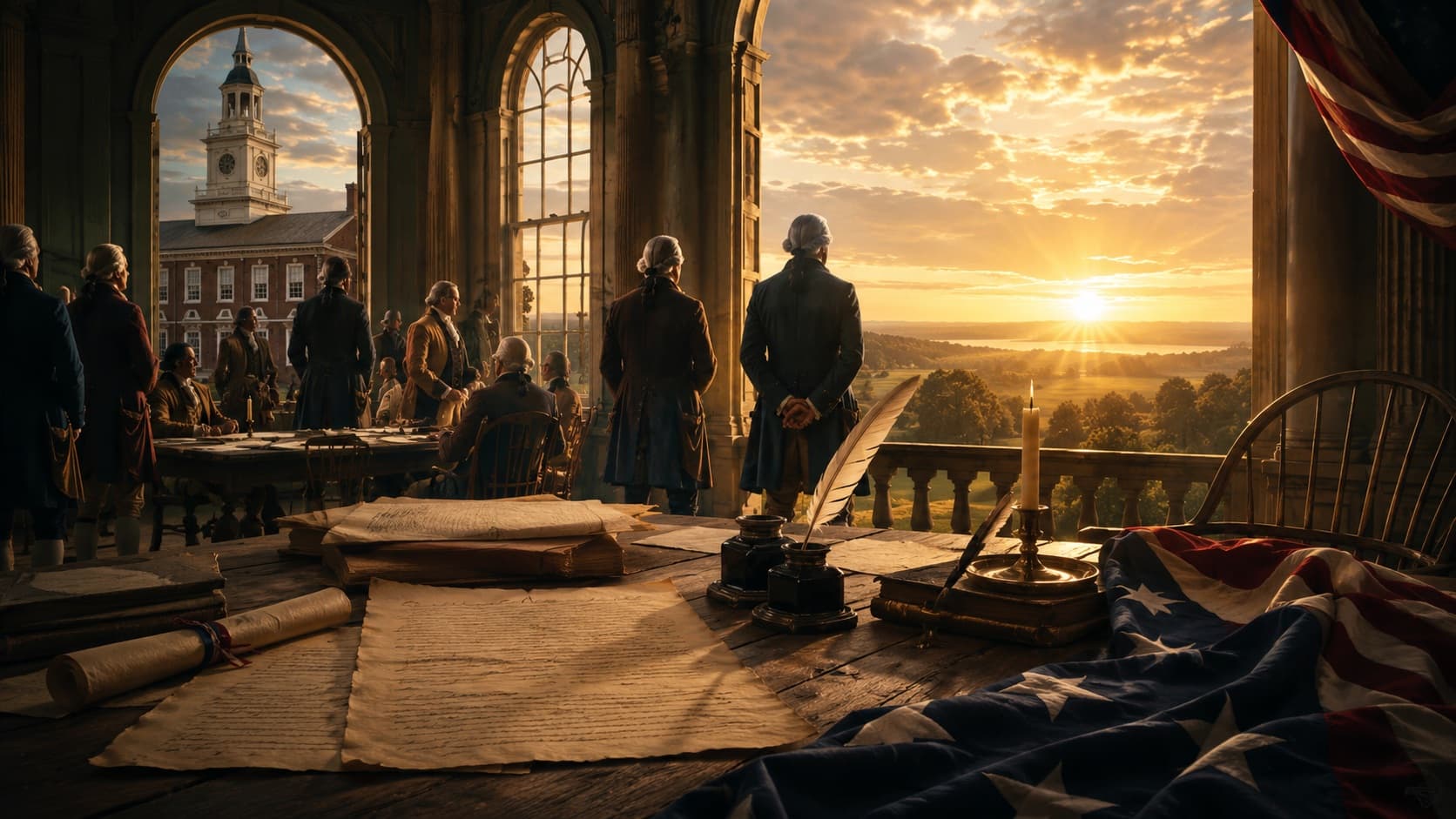
American Exceptionalism Series · Article 2 of 8
The Declaration of Independence and the Universal Claim of Liberty
A Declaration That Changed the Meaning of Revolution
The Declaration of Independence is one of the most consequential political documents in world history because it did more than announce that thirteen British colonies were separating from the British Empire. It explained why they had the right to do so. That distinction matters. The Declaration was not merely a notice of rebellion. It was a moral argument, a legal brief, a statement of national birth, and a universal claim about the nature of human liberty.
Many revolutions in history have been struggles over power: one dynasty against another, one faction against another, one ruling class against another. The American Revolution certainly involved practical grievances — taxation, trade restrictions, military occupation, colonial rights, and the abuse of royal authority. But the Declaration lifted those grievances into a larger principle. It claimed that government exists for the sake of human beings, not the other way around. It insisted that rulers are not masters by birth, that people are not subjects by nature, and that political power is legitimate only when it rests on the consent of the governed.
That was a radical claim in 1776. Much of the world was still governed by kings, emperors, hereditary aristocracies, established churches, and rigid social hierarchies. The Declaration challenged that older order. It said that rights do not come from Parliament, king, custom, or privilege. They come from a higher source. They belong to human beings by nature.
This is why the Declaration remains central to any serious discussion of American exceptionalism. America was not founded merely as a new country. It was founded on a proposition about liberty.
“All Men Are Created Equal”
The most famous words of the Declaration are also the most demanding: “We hold these truths to be self-evident, that all men are created equal.” These words have been quoted so often that their radical force can be easy to miss. They did not mean that all people are equal in talent, wealth, virtue, strength, wisdom, or achievement. The Founders were not claiming that human beings are identical. They were claiming something more foundational: that no person is born with a natural right to rule another, and no person is born without a moral claim to life, liberty, and justice.
The phrase “created equal” grounded political equality in the nature of the human person. It declared that human dignity is not granted by government. Because rights come before government, government must be judged by how well it protects them. This idea became one of the great engines of American history.
The Declaration identifies certain rights as unalienable, including life, liberty, and the pursuit of happiness. The word “unalienable” means that these rights cannot rightly be surrendered, sold, or taken away by ordinary political power. A government may violate them, but it does not own them. A law may deny them, but it does not erase them. A king may trample them, but he cannot make them morally void.
This was the Declaration’s central claim: legitimate government is not based on force, inheritance, or command. It is based on the protection of rights. When government becomes destructive of those rights, the people have the authority to alter or abolish it and establish a new government better suited to securing their liberty.
That principle transformed the American Revolution from a colonial dispute into a universal argument.
Rights Before Government
The Declaration’s view of liberty begins with a simple but powerful order of ideas. First, human beings possess rights. Second, governments are created to secure those rights. Third, governments receive their just powers from the consent of the governed. Fourth, when a government betrays its purpose, the people may replace it.
This order is central to the American political tradition. It means that the state is not the highest authority in human life. Government is necessary, but it is limited. It has real power, but that power is delegated. It can make laws, collect taxes, punish crimes, and defend the nation, but it cannot rightly redefine the human person as property of the state.
The Declaration therefore established a standard by which all government action could be measured. Does government protect life, liberty, property, conscience, family, worship, speech, and lawful opportunity? Or does it reduce citizens to dependents, subjects, or instruments of power?
The American Founders understood that liberty without government can collapse into disorder. But they also understood that government without liberty becomes tyranny. The Declaration did not reject government. It rejected unlimited government. It rejected rule without consent. It rejected the idea that distant authorities could govern a people while disregarding their rights, customs, assemblies, and petitions.
The American Revolution was therefore a defense of ordered liberty. The colonists were not trying to escape law itself. They were trying to restore the principle that law must be tied to representation, justice, and the rights of Englishmen — and then, in the Declaration, to the broader rights of mankind.
The Grievances Against King George III
Although the opening principles of the Declaration are its most famous lines, most of the document consists of specific charges against King George III. These grievances mattered because the signers wanted to show that separation was not rash or emotional. It was the result of repeated abuses.
The Declaration accused the king of obstructing colonial laws, dissolving representative bodies, interfering with justice, maintaining standing armies in peacetime, imposing taxes without consent, cutting off trade, and waging war against the colonies. The list was designed to prove that the British government had violated the proper ends of government.
This structure is important. The Declaration does not say that people may overthrow government whenever they are frustrated. In fact, it says that “prudence”teaches that long-established governments should not be changed for “light and transient causes.” The American argument was not casual rebellion. It was that a long pattern of abuse had revealed a design to reduce the colonies under absolute power.
In other words, the Declaration joined principle with evidence. It proclaimed universal rights, then argued that those rights had been violated in concrete ways. This gave the American cause moral seriousness. The signers were not merely asserting independence; they were justifying it before the world.
The Courage of the Signers
The men who signed the Declaration were not writing from safety. They were committing treason against the British Crown. If the Revolution failed, they could have lost their property, liberty, or lives. The closing pledge — “our Lives, our Fortunes and our sacred Honor” — was not decorative language. It expressed the personal risk behind the public act.
The signers came from different colonies, regions, religious backgrounds, and economic circumstances. They disagreed on many issues, and they were not saints. Yet they shared a conviction that the American cause had reached a decisive moment. They believed that the colonies could no longer preserve their liberties while remaining under British rule.
Their decision required more than anger. It required confidence that free people could build something better. Independence meant war, uncertainty, financial hardship, diplomatic danger, and the possibility of failure. The Declaration was therefore an act of political courage. It placed the American people on a path from protest to nationhood.

The Great Contradiction: Liberty and Slavery
No honest discussion of the Declaration can ignore the glaring contradiction between its language of equality and the existence of slavery in the new nation. Many of the same colonies that declared all men created equal permitted human bondage. Some of the Founders owned slaves. Enslaved men and women were denied the very rights the Declaration described as unalienable.
This contradiction was real, grave, and morally consequential. But it did not make the Declaration meaningless. In a strange and powerful way, it made the Declaration dangerous to slavery. By stating a universal principle, the Declaration created a standard that slavery could not satisfy. It placed into American public life an idea that would eventually be used to attack the institution that violated it most completely.
The Declaration did not immediately end slavery. The Constitution later compromised with slavery in ways that reflected the political realities and moral failures of the time. Yet the language of the Declaration remained alive. Anti-slavery Americans returned to it again and again. They argued that the nation’s founding creed condemned the ownership of human beings.
Frederick Douglassunderstood this deeply. In his famous 1852 address, he condemned America’s hypocrisy while also recognizing the power of its founding principles. He did not treat the Declaration as worthless. He treated it as a standard by which America stood judged. Abraham Lincolndid the same. Lincoln saw the Declaration as the moral center of the American experiment. For him, the Constitution was the frame of silver, but the Declaration’s principle of liberty was the apple of gold.
The Civil War would eventually force the nation to confront the contradiction directly. The Emancipation Proclamation, the Union victory, and the 13th Amendment did not represent a rejection of the Declaration. They represented a long-delayed fulfillment of its central promise.
A Document for Reformers and Patriots
One reason the Declaration has endured is that it has served both patriots and reformers. It gives citizens a way to love their country without pretending the country has always lived up to its ideals. It allows Americans to criticize injustice not by abandoning the founding, but by appealing to it.
This pattern has repeated throughout American history. The movement to abolish slavery invoked the Declaration. Women’s rights advocates drew on its language at Seneca Falls. Civil rights leaders appealed to the promise of equality and the constitutional principles that grew from the founding. Immigrants arriving in America often understood the Declaration as part of the national creed they were joining. Soldiers carried its meaning into conflicts where the survival of liberty was at stake.
The Declaration’s genius is that it speaks beyond its immediate moment. It was written for a specific crisis in 1776, but its principles were larger than the crisis. It gave future generations a vocabulary of liberty: equality, rights, consent, justice, tyranny, and self-government.
That vocabulary remains essential. A free people must be able to explain why freedom matters. They must know that rights are not favors from the powerful. They must understand that government is their servant, not their master. The Declaration teaches these truths with unusual clarity.
The Universal Claim of Liberty
The Declaration is an American document, but its claim is universal. It does not say that English colonists alone possess rights. It does not say that liberty belongs only to one class, tribe, race, or nation. It says that human beings are created equal in their possession of natural rights.
This universal language helped make America a symbol around the world. People under tyranny, occupation, caste systems, and empire have often looked to the American founding as proof that political life can be built on consent rather than domination. The United States has not always lived up to that role, and American foreign policy has often involved difficult tradeoffs, mistakes, and conflicts. But the Declaration’s principle remains larger than any one administration or era.
At its core, the Declaration says that the human person has a dignity that politics must respect. That claim is not outdated. If anything, it is permanently relevant. In every age, there are rulers, parties, ideologies, and bureaucracies tempted to treat people as tools of power. The Declaration stands against that temptation. It says that the purpose of government is to secure the rights of the people.
Liberty and Responsibility
The Declaration’s vision of liberty is not a license for selfishness or disorder. The Founders understood that self-government requires self-control. A people claiming the right to govern themselves must also accept the responsibility to govern themselves wisely.
Liberty requires virtue. It requires citizens capable of telling the truth, keeping promises, respecting law, defending the innocent, honoring family and community obligations, and sacrificing for the common good when necessary. The Declaration opened the door to independence, but independence alone could not sustain a republic. That work required institutions, habits, education, faith, local responsibility, and civic courage.
This is why the Declaration must be read alongside the Constitution, the Bill of Rights, the Northwest Ordinance, the Federalist Papers, Lincoln’s speeches, and the long record of American civic life. The Declaration announced the moral purpose of the American experiment. The generations that followed had to build, defend, amend, and renew that experiment.
Why the Declaration Still Matters
Nearly 250 years after its adoption, the Declaration of Independence still matters because the questions it raises have not disappeared. Are rights permanent or temporary? Does government serve the people, or do the people serve the government? Is equality rooted in human dignity, or granted by political power? Can a free people preserve liberty across generations?
The Declaration answers these questions with confidence. It teaches that human beings possess rights by nature. It teaches that government must be limited by justice. It teaches that consent matters. It teaches that liberty is worth sacrifice.
For Americans, the Declaration is not merely an artifact behind glass. It is a national inheritance. It reminds citizens that the United States was born from a bold claim: that people are capable of self-government because they are not subjects by nature. They are rights-bearing persons, responsible before God and one another, capable of forming communities, laws, and institutions that protect freedom.
The Declaration does not ask Americans to believe their country has been flawless. It asks them to remember what their country is for.
That is why the Declaration remains one of the central texts of American exceptionalism. It transformed independence into a moral cause. It gave the nation a standard higher than convenience or power. It inspired reformers to correct injustice, patriots to defend liberty, immigrants to seek a new life, and citizens to preserve the republic.
The Declaration’s enduring message is simple, demanding, and revolutionary: liberty is not a gift from rulers. It is the birthright of human beings. Government exists to secure it. And every generation must decide whether it will honor that truth.
Part of the American Exceptionalism Series
View All Articles in the Series