Presidents Day
Third Monday in February
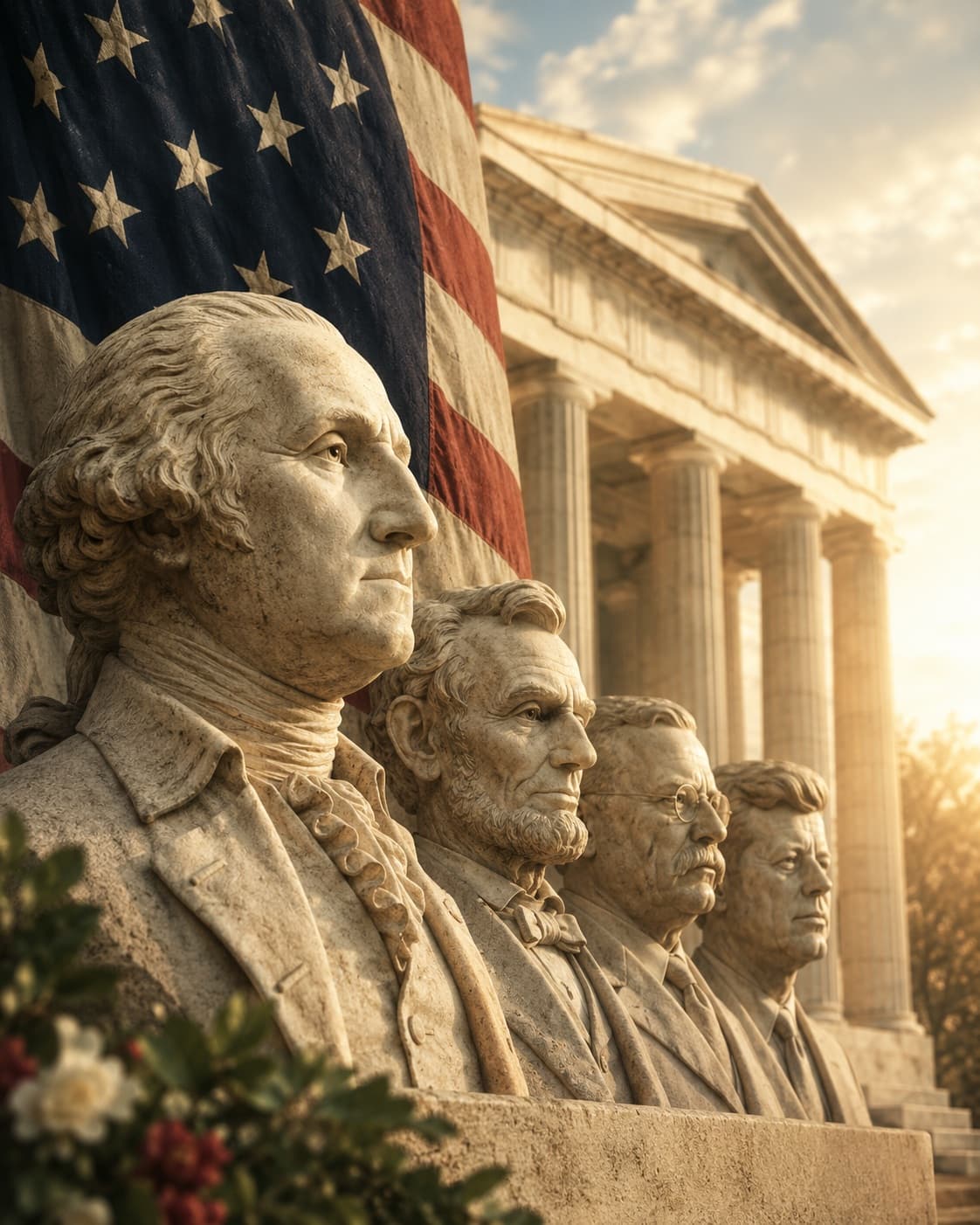
Presidents Day is an opportunity to reflect on the American presidency and the remarkable leaders who have guided the nation across 250 years. From Washington's founding of the office to Lincoln's preservation of the Union, from Theodore Roosevelt's conservation of the land to Ronald Reagan's role in ending the Cold War, the presidency is one of America's most enduring and consequential civic institutions. Presidents Day invites every American to appreciate the leaders who shaped the republic.
What It Commemorates
Presidents Day originally commemorated the birthday of George Washington, born February 22, 1732 — the Revolutionary War commander-in-chief, presiding officer of the Constitutional Convention, and first President of the United States. Over time the holiday grew to honor all American presidents, with particular reverence for Abraham Lincoln, born February 12, 1809, who preserved the Union during the Civil War and is widely regarded as America's greatest president.
Historical Background
George Washington's Birthday was one of America's earliest patriotic observances, celebrated informally since the late 18th century and established as a federal holiday in 1879. The Uniform Monday Holiday Act of 1968 moved the observance to the third Monday in February. Many Americans and all 50 states now treat the day as a celebration of all American presidents.
Why It Matters
Presidents Day invites Americans to reflect on leadership, civic duty, and the remarkable endurance of constitutional government. Washington defined the presidency as an office of service and character. Lincoln held the nation together through its greatest crisis. Their examples remind Americans that self-government depends on leaders of integrity and citizens who hold them to account.
How Americans Observe It
Americans observe Presidents Day with educational programs about the presidency and American history, visits to presidential libraries and historic sites, patriotic ceremonies, and special recognition of Washington and Lincoln. Schools teach about the presidents, and many families visit presidential monuments in Washington, D.C.
America 250 Connection
Presidents Day& the 250th Anniversary
As America marks 250 years, Presidents Day offers a chance to reflect on the full arc of American presidential leadership — 46 presidents across 250 years, each serving a constitutional republic that Washington himself helped design. The peaceful transfer of power, practiced since 1797, remains one of America's most remarkable civic achievements.
About Presidents Day
What Presidents Day Commemorates
Presidents Day honors the American presidency and the remarkable men who have held the office — from George Washington, who defined it, to the leaders who have guided the republic through peace and crisis across 250 years. The holiday began as a celebration of Washington's birthday and has grown into a day to appreciate the full tradition of American presidential leadership.
Washington's voluntary relinquishment of power after two terms — setting a precedent that stunned the world — and Lincoln's resolve in preserving the Union during the Civil War stand as two of the greatest acts of leadership in the history of democracy.
Historical Background
George Washington's Birthday was one of America's earliest patriotic celebrations, observed informally during Washington's own lifetime. Congress officially established it as a federal holiday in 1879, making Washington the first American honored with a federal holiday.
The Uniform Monday Holiday Act of 1968 moved the observance to the third Monday in February, placing it between Washington's birthday of February 22 and Lincoln's of February 12. Over time, most Americans and all 50 states began treating the day as a celebration of all presidents. Abraham Lincoln, widely regarded as America's greatest president, now shares the unofficial spotlight with Washington.
Why It Matters
Presidents Day matters because the American presidency is one of the most consequential offices in the history of self-government. Washington founded it with a commitment to service and voluntary restraint of power. Lincoln preserved the Union and signed the Emancipation Proclamation. Theodore Roosevelt expanded the national park system. Franklin Roosevelt led the nation through the Great Depression and World War II. Ronald Reagan helped bring the Cold War to a peaceful end.
The presidency is an institution that has guided the United States through its greatest challenges — and Presidents Day is an invitation to study and appreciate that tradition.
How Americans Observe It
Americans observe Presidents Day with educational programs about the presidency and American history, visits to presidential libraries and historic sites, patriotic ceremonies, school lessons about Washington and Lincoln, and visits to the Lincoln Memorial and Washington Monument in the nation's capital. Many communities host programs about the founders, and the day is an occasion for patriotic reflection on the endurance of constitutional self-government.
Connection to America 250
As America marks 250 years, Presidents Day offers a chance to reflect on the full arc of American presidential leadership — 46 presidents serving a constitutional republic across 250 years. The peaceful transfer of power, practiced without interruption since Washington handed the presidency to John Adams in 1797, is one of the most remarkable achievements in the history of democracy.
Presidents Day 2026 invites Americans to appreciate the office Washington created, Lincoln preserved, and every president since has served — a living institution at the heart of the American republic.
Historical Note
George Washington voluntarily relinquished power after two terms — a decision that stunned much of the world and strengthened American democracy. His Farewell Address of 1796, warning against factionalism and foreign entanglement, remains one of the most important statements of American civic wisdom.
Frequently Asked Questions
What does Presidents Day commemorate?
Presidents Day honors all American presidents, with special recognition of George Washington, the first president and father of the nation, and Abraham Lincoln, who preserved the Union and is widely regarded as America's greatest president.
When is Presidents Day observed?
Presidents Day is observed on the third Monday in February, near George Washington's birthday of February 22 and Abraham Lincoln's birthday of February 12.
How does Presidents Day connect to America 250?
America 250 marks the 250th anniversary of the nation's founding. Presidents Day invites Americans to appreciate the 46 presidents who have guided the republic from Washington's era to the present, and the remarkable continuity of constitutional government across two and a half centuries.
Related

Ask Dr. Abigail Hart
AI Historical Guide · America 250 Atlas
Have a question about this topic? Dr. Hart can help you explore the context, connections, and meaning behind America’s history.