American Exceptionalism Series · Article 7 of 8
American Innovation: From Practical Invention to Technological Leadership
The Inventive Republic
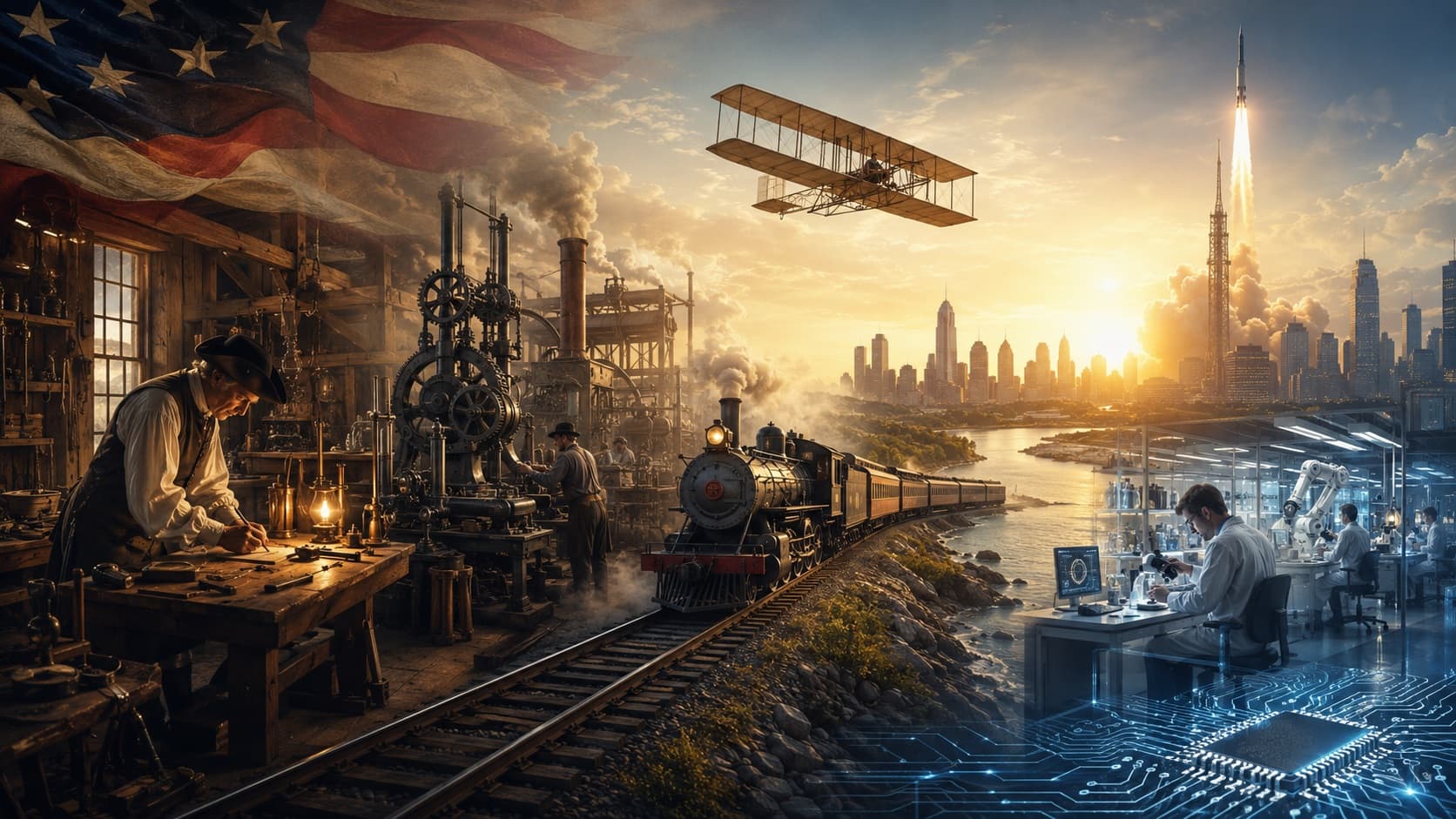
American exceptionalism has never been only about political ideals or economic liberty in the abstract. It has been demonstrated, again and again, in the concrete creation of new things: tools, machines, systems, medicines, communications technologies, and industries that changed daily life for Americans and, in many cases, for the entire world.
From the earliest years of the republic, Americans displayed a distinctive appetite for practical invention. Visitors from Europe remarked on it with a mixture of admiration and bemusement. Americans were not primarily interested in abstract theory. They wanted things that worked. They wanted to know how to make farms more productive, rivers more navigable, distances shorter, work less exhausting, and life more comfortable.
That appetite for practical improvement, combined with a constitutional system that protected intellectual property, a free market that rewarded successful innovation, and a culture that celebrated the self-made inventor, produced a record of technological achievement unmatched in the modern world.
Understanding American innovation is essential to understanding why the United States became the kind of nation it became, how it accumulated such economic and military power, and why its example has so often inspired admiration and imitation around the world.
A Founding Framework for Invention
The founders understood that innovation required incentives. The United States Constitution, ratified in 1788, explicitly authorized Congress to promote science and the useful arts by “securing for limited Times to Authors and Inventors the exclusive Right to their respective Writings and Discoveries.” This clause, sometimes called the Intellectual Property Clause, established a system of patents and copyrights from the republic’s earliest days.
The Patent Act of 1790, one of the first pieces of legislation passed by Congress, created a formal process for inventors to secure legal protection for new and useful inventions. Patents gave inventors a time-limited monopoly on their creations, allowing them to earn a return on their effort and investment before the invention became freely available to all.
This legal framework was democratizing in an important sense. Unlike the guild systems of Europe or the patronage networks of royal courts, the American patent system was open to anyone. A farmer with a new idea for a plow, a mechanic with a better engine design, a seamstress with an improved sewing machine — all could apply for patent protection. The system did not require connections, birthright, or aristocratic sponsorship. It required only a novel and useful idea.
The result was a flood of applications. American inventors filed patents at extraordinary rates throughout the nineteenth and twentieth centuries. The patent system became one of the institutional engines of American technological progress.
Benjamin Franklin and the Practical Mind
Benjamin Franklin remains the emblematic figure of early American innovation. Franklin was not only a statesman, diplomat, and founding father. He was a scientist, inventor, and entrepreneur whose work linked practical curiosity to civic purpose.
His experiments with electricity — famously including the kite-and-key experiment in a thunderstorm — led to the invention of the lightning rod, which protected buildings and ships from lightning strikes. Franklin invented bifocal glasses, the Franklin stove (a more efficient fireplace), and the flexible urinary catheter. He founded one of America’s first learned societies, the American Philosophical Society, and organized the first subscription library in Pennsylvania.
What distinguished Franklin’s approach was its combination of intellectual seriousness and practical orientation. He was not interested in science as abstract philosophy alone. He wanted to know how natural principles could be applied to make life safer, more comfortable, and more productive. He also refused to patent his inventions, believing that knowledge should serve the public good.
Franklin embodied the character of the ideal American inventor: curious, practical, public-spirited, willing to experiment, unimpressed by hierarchy, and motivated by the conviction that the world could be improved by human effort and intelligence.
Innovation on the Farm and Frontier
Early American innovation was closely connected to the agricultural economy. The most pressing problems facing most Americans in the late eighteenth and early nineteenth centuries were farming problems: how to clear land, till soil, plant crops, harvest grain, and process agricultural products efficiently.
Eli Whitney’s cotton gin (1793) mechanized the separation of cotton fibers from seeds, dramatically increasing the productivity of cotton production. Unfortunately, this invention also dramatically expanded the demand for enslaved labor in the South, accelerating the spread of slavery even as Northern industry was reducing the economic role of bound labor.
Cyrus McCormick’s mechanical reaper(1831) transformed grain harvesting. Before the reaper, wheat had to be cut by hand — a slow, labor-intensive process that limited how much land a farm family could cultivate. The reaper allowed a farmer to harvest many times more grain with far less human effort. It made American agriculture productive on a continental scale and helped feed growing industrial cities.
The frontier itself encouraged innovation. American settlers faced practical challenges in environments where established European techniques did not work as well. Adaptation, improvisation, and practical problem-solving became cultural habits shaped by necessity.
The Industrial Age and the Rise of Systems
The second half of the nineteenth century brought a new scale to American innovation. Individual inventors continued to matter, but the great innovations of the Gilded Age often involved not just single inventions but entire systems: ways of organizing machines, labor, logistics, capital, and distribution to create unprecedented productive capacity.
The railroadwas the first great American industrial system. It required precise engineering, standardized track gauges, coordinated schedules, telegraph communications, standardized time zones (which America adopted to manage railroad schedules), and massive capital investment. The railroad companies were among the first large corporations in American history, and they developed management practices — accounting methods, organizational structures, middle management roles — that would later be applied to other industries.
Andrew Carnegie’s steel mills used the Bessemer process not as a single innovation but as part of an integrated system: from iron ore mining, through transportation, to steel production, finishing, and distribution. The result was steel so cheap and plentiful that it transformed construction, transportation, and machinery throughout the economy.
Eli Whitney’s concept of interchangeable parts— manufacturing components to uniform standards so they could be assembled from any stock and repaired with standard replacements — laid the foundation for what would later be called the American system of manufacturing. This system made mass production possible and eventually made American industrial goods cheaper and more reliable than those of competitors.
Edison, Bell, and the Age of Applied Invention
The late nineteenth century produced two inventors whose work transformed daily life more profoundly than almost any other: Thomas Edison and Alexander Graham Bell.
Edison’s Menlo Park laboratoryin New Jersey became the world’s first industrial research laboratory — a place where invention was systematic rather than accidental. Edison and his team produced the phonograph, the practical incandescent light bulb, a system for electrical power generation and distribution, improvements to the telegraph and telephone, and the motion picture camera, among dozens of other inventions.
Edison’s genius was not only technical. It was entrepreneurial. He did not invent the light bulb in isolation. He invented a complete electrical system: generators, distribution lines, meters, switches, and the light bulbs themselves — everything needed to bring electric light into homes and businesses. He built the first central power station in lower Manhattan in 1882. Within years, his model was being replicated in cities around the world.
Alexander Graham Bell’s telephone(1876) created an entirely new medium of personal communication. Within a generation, the telephone had transformed business, journalism, medicine, government, and social life. The combination of Bell’s invention and American entrepreneurship produced a national telephone network that became one of the great infrastructure achievements of the nineteenth century.
Flight and the Conquest of Distance
On December 17, 1903, Orville and Wilbur Wright made the first powered, controlled, sustained flight in a heavier-than-air machine at Kitty Hawk, North Carolina. The flight lasted twelve seconds and covered 120 feet. Within a few years, the Wright brothers were flying circuits of several miles.
The achievement of the Wright brothersis a particularly American story. They were not university scientists or government researchers. They were bicycle mechanics from Dayton, Ohio — practical engineers who attacked the problem of flight through systematic experimentation, careful observation, and incremental improvement. They worked without government funding, without university credentials, and against the skepticism of experts who believed flight was impossible.
Their success represents the American tradition of practical inventorship at its best: ordinary people with extraordinary persistence, attacking a real problem with available tools and disciplined minds.
Aviation transformed warfare, commerce, travel, and geography within a generation. By the mid-twentieth century, the American aerospace industry — built on the foundations laid by the Wright brothers — dominated the world.
War, Research, and National Mobilization
The two World Wars dramatically accelerated American technological development. In both conflicts, the United States mobilized its industrial and scientific capacity at a scale that no other nation could match.
World War I revealed the military importance of industrial capacity. American factories produced the munitions, vehicles, aircraft, and supplies that helped tip the war in favor of the Allies. American engineers contributed to improvements in communications, transportation, and weapons systems.
World War II produced the most concentrated burst of applied scientific and technological development in history. The United States mobilized academic scientists, corporate engineers, and military researchers in collaborative efforts that produced radar, penicillin (developed at scale by American pharmaceutical companies), the Manhattan Project (the atomic bomb), improved aircraft, amphibious landing craft, and dozens of other technologies.
The Office of Scientific Research and Development, led by Vannevar Bush, coordinated the wartime research effort and laid the intellectual foundation for the postwar relationship between government, universities, and science. Bush’s 1945 report, Science: The Endless Frontier, argued that government investment in basic research was essential to national security and economic progress. His vision led to the creation of the National Science Foundation and shaped American science policy for decades.
The Space Age
On July 20, 1969, Neil Armstrong and Buzz Aldrin became the first human beings to walk on the moon. The Apollo 11 mission was one of the most spectacular achievements in the history of human civilization. It required eleven years of intensive national effort, the work of hundreds of thousands of engineers, scientists, technicians, and workers, and the expenditure of enormous public and private resources.
The space program demonstrated American technological capability at its most dramatic. But the space race had begun as a response to a Soviet challenge. The launch of Sputnikin 1957 — the first Earth-orbiting satellite — shocked American public opinion and galvanized government investment in science education and research.
President John F. Kennedy’s 1961 commitment to land a man on the moon before the end of the decade turned a competition into a national purpose. The National Aeronautics and Space Administration(NASA), founded in 1958, became one of the great institutions of American applied science. Its achievements — Mercury, Gemini, Apollo, the Space Shuttle, the International Space Station, the Mars rovers, the Voyager probes — represent a sustained record of technical excellence.
The space program’s technological legacy extended far beyond space itself. The miniaturization requirements of spacecraft electronics pushed the development of integrated circuits. Materials research for spacecraft found applications in medicine, construction, and consumer goods. The demands of the space program were a powerful driver of American technological development across many sectors.
Computers, Silicon Valley, and the Digital Revolution
The second half of the twentieth century brought the most consequential technological transformation since the Industrial Revolution: the invention of electronic computers and the digital revolution that followed.
Early computing development occurred in both government and academic settings. ENIAC (1945), built at the University of Pennsylvania with military funding, was one of the first general-purpose electronic computers. IBM dominated early commercial computing with mainframe machines used by large corporations and government agencies.
The critical transformation came with the development of the microprocessor. Intel’s 4004 chip (1971) placed an entire processing unit on a single silicon chip. Rapid improvements in semiconductor technology, following what became known as Moore’s Law (the observation that the number of transistors on a chip doubles approximately every two years), drove exponential growth in computing power at rapidly falling cost.
The personal computer revolution of the late 1970s and 1980s brought computing out of corporate data centers and into homes, schools, and small businesses. Apple, founded by Steve Jobs and Steve Wozniak in a garage in 1976, and Microsoft, founded by Bill Gates and Paul Allen, became two of the most valuable companies in the world.
The development of the internet— growing out of the government-funded ARPANET research network — transformed communication, commerce, journalism, entertainment, education, and governance. The World Wide Web, email, search engines, social networks, e-commerce, and streaming media all emerged from the combination of American research, entrepreneurship, and open networks.
Silicon Valley— the cluster of technology companies, venture capital firms, research universities, and startup culture centered in the San Francisco Bay Area — became the most prolific engine of technological entrepreneurship in world history. Google, Amazon, Facebook, Netflix, Uber, Airbnb, and hundreds of other companies were founded there or grew in that ecosystem.
Medicine, Biotechnology, and the Defense of Life
American innovation in medicine and biotechnology has been equally remarkable. American pharmaceutical and medical device companies have produced a disproportionate share of the world’s new drugs, medical devices, and treatment protocols.
American universities and research hospitals have produced major advances in understanding cancer, heart disease, infectious disease, genetics, and neuroscience. The development of mRNA vaccine technology— which made possible the rapid development of COVID-19 vaccines — drew on decades of American academic and corporate research investment.
The American system’s combination of strong intellectual property protection, competitive pharmaceutical markets, high research investment (both public and private), and regulatory frameworks designed to balance safety with speed of approval has consistently produced medical innovations that have extended and improved human life around the world.
Immigrants and the American Innovation Engine
Throughout American history, immigrants have played a disproportionate role in technological innovation. Alexander Graham Bell was born in Scotland. Andrew Carnegie came from Scotland. Nikola Tesla, whose work on alternating current helped electrify the modern world, was born in Serbia. Albert Einstein fled Nazi Germany for America. Enrico Fermi, a key figure in the Manhattan Project, came from Italy.
In the modern era, immigrants from India, China, Taiwan, Israel, Russia, and dozens of other countries have founded companies, led research laboratories, and contributed essential technical expertise to Silicon Valley and American research universities. Studies consistently show that immigrants are overrepresented among patent holders, company founders, and Nobel laureates in science working in the United States.
This pattern reflects one of the most powerful dynamics of American exceptionalism: a free, open society that rewards merit over ancestry attracts and retains ambitious people from across the world who then contribute to national prosperity and capability. The American innovation economy has been continuously renewed by the energy and talent of immigrants who chose America because it offered freedom, opportunity, and the chance to build something new.
Free Enterprise and the Scaling of Ideas
One of the most important institutional features of American innovation has been the ability to scale new ideas into mass markets. An invention that remains a curiosity or a prototype does not transform the world. Transformation happens when an invention becomes accessible and affordable to ordinary people.
American free enterprise created the mechanisms for scaling: venture capital, stock markets, entrepreneurial management, mass production, national distribution networks, and a consumer culture willing to adopt new products and services. The distance between a laboratory prototype and a mass-market product was shorter in America, and the pathways were more reliably traveled, than in most other economies.
This explains why many technologies invented elsewhere — or developed in parallel in other nations — were commercialized and popularized in the United States. The steam engine was perfected in Britain but the American railroad and steamboat industries scaled it. The World Wide Web was proposed by a British scientist at a European research laboratory, but the commercial internet that transformed global communication was built primarily by American companies. The smartphone integrated technologies from many sources, but Apple’s iPhone (2007) defined the category and created the modern app economy.
The Moral Responsibilities of Technological Power
American technological innovation has not been morally uncomplicated. New technologies have repeatedly created new possibilities for harm as well as benefit.
The cotton gin expanded slavery. Industrial pollutants poisoned rivers and air. The automobile killed hundreds of thousands of Americans through accidents and contributed to urban sprawl and environmental degradation. Nuclear weapons introduced unprecedented destructive power. Social media platforms have amplified disinformation, polarization, and psychological harm alongside their genuine benefits for communication and community.
Every era of American technological development has required moral reckoning: What are the costs? Who bears them? What limits should be set? By whom and through what processes? These questions have never been fully resolved, and they are not unique to America. But the scale of American technological power makes the questions more urgent.
A nation that produces technologies with global impact carries global responsibilities. The values embedded in how those technologies are designed, deployed, regulated, and traded matter beyond America’s borders. American exceptionalism, if it is to mean anything serious, must include a commitment to using technological power in ways consistent with the nation’s founding principles: the dignity of persons, the rule of law, and the protection of liberty.
Why American Innovation Matters
American innovation matters to the story of American exceptionalism because it demonstrates the connection between freedom and human flourishing. A society that protects intellectual property, rewards risk-taking, allows capital to flow toward new ideas, welcomes ambitious immigrants, values practical problem-solving, and maintains a culture of enterprise and competition will tend to produce more innovation than one that does not.
The American innovation record is not proof that Americans are somehow genetically more creative than other peoples. It is evidence that institutions, culture, and incentives matter. The same human capacity for curiosity and inventiveness that exists everywhere has been unleashed more fully in America by the combination of liberty, property rights, rule of law, entrepreneurship, and open competition.
American innovation also matters because its results have benefited not only Americans but humanity as a whole. The light bulb, the telephone, the airplane, the transistor, the personal computer, the internet, the mRNA vaccine — these are not merely American achievements. They are contributions to the common heritage of humanity. The world is richer, healthier, more connected, and in many ways more free because of American innovation.
The Future of the Inventive Republic
As the United States approaches its 250th anniversary, the tradition of American innovation faces new challenges. Technological competition from other nations — particularly China — is more serious than at any point since the Cold War. Questions about artificial intelligence, genetic engineering, quantum computing, and energy systems raise challenges that will require the best of American scientific, entrepreneurial, and civic capacity.
The record of the past suggests reasons for confidence. American innovation has repeatedly been declared in crisis, only to renew itself through the energy of new entrepreneurs, researchers, immigrants, and institutions. The culture of practical ingenuity, the tolerance for failure and risk, the constitutional protection of intellectual property, and the competitive economy that rewards successful innovation remain real and powerful.
But confidence must be earned, not assumed. The future of American innovation depends on the same things the future of the American republic depends on: honest institutions, rule of law, strong education, freedom of inquiry and speech, openness to talent from wherever it comes, and a culture that continues to believe that the world can be understood, improved, and made more just through disciplined human effort.
From Franklin’s lightning rod to the moon landing to the digital revolution, the story of American innovation is the story of a free people asking the question their founding tradition invites: How can this be better? The answer, generation after generation, has been the same: with liberty, discipline, ingenuity, and the conviction that the future is worth building.
Part of the American Exceptionalism Series
View All Articles in the Series