American Exceptionalism Series · Article 6 of 8
A Civil War to End Slavery: America's Republic Tested
The Republic’s Greatest Test
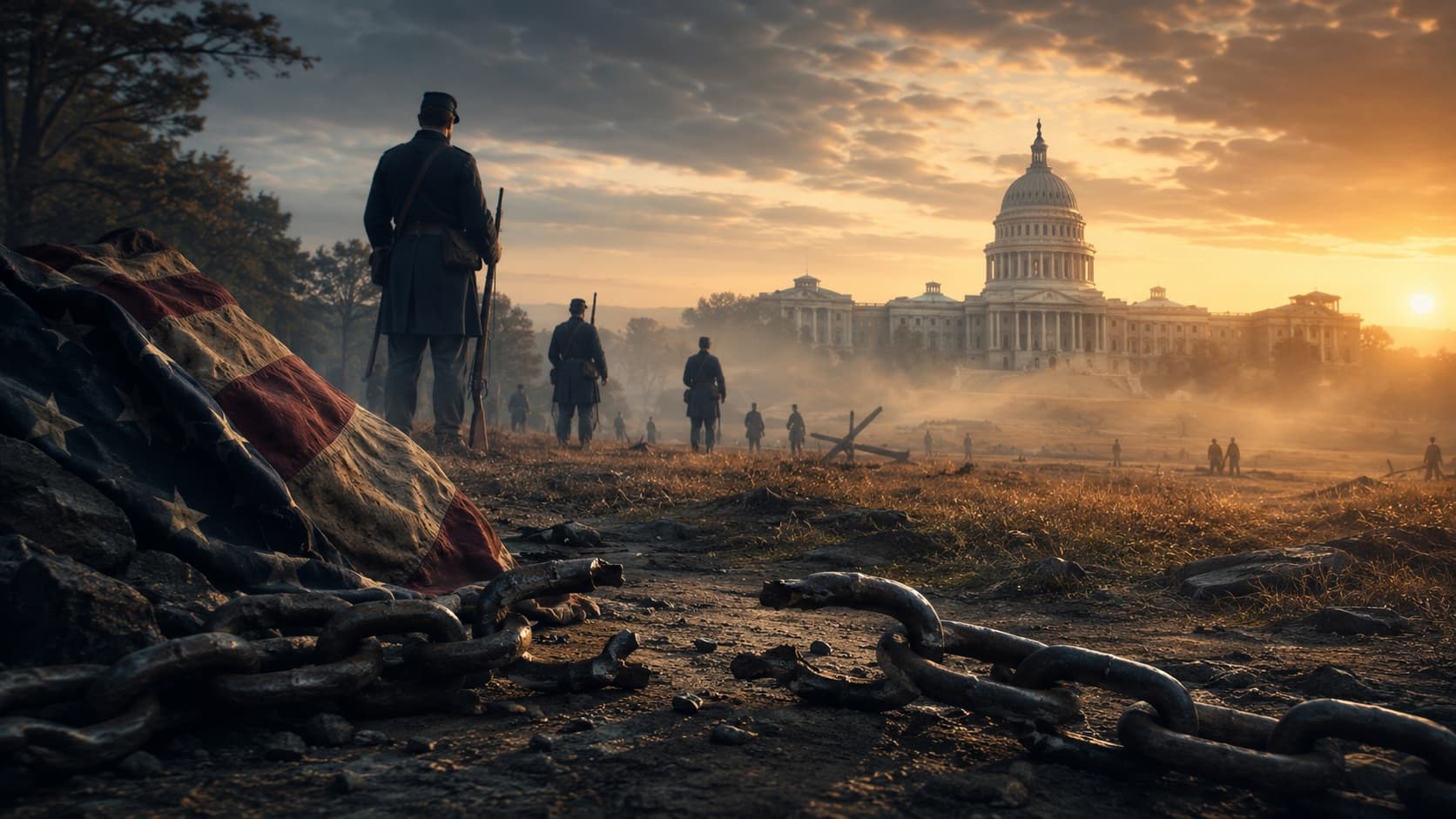
The Civil Warwas the most severe test the United States ever faced. Between 1861 and 1865, the nation was torn apart by a conflict that claimed the lives of more than 600,000 soldiers — more Americans than in any other war the country has fought before or since. Families were divided. Cities burned. Farms and plantations were destroyed. The constitutional system itself was strained to the point of breaking.
Yet the war also resolved what the founding generation had been unable or unwilling to resolve: the existence of slavery in a republic founded on the principle that all men are created equal. The outcome — Union preserved, slavery abolished, constitutional order maintained — is one of the most remarkable events in the political history of the modern world.
Understanding the Civil War is essential to understanding American exceptionalism. It reveals both the profound failure of the American founding to live up to its own ideals and the eventual willingness of the republic to pay an enormous cost to correct that failure. It shows a nation capable of both moral catastrophe and moral renewal.
The Unfinished Question at the Founding
The Declaration of Independence proclaimed that all men are created equal and endowed with unalienable rights. The Constitution, ratified in 1788, protected slavery. It counted enslaved people as three-fifths of a person for the purpose of apportionment, prohibited Congress from ending the Atlantic slave trade before 1808, and required free states to return escaped slaves.
This contradiction was not invisible to the founders. Many of them knew slavery was morally wrong. George Washington wrote about the need to see slavery end. Thomas Jefferson, himself a slaveholder, called it a moral and political evil. John Adams opposed it throughout his career.
But the founding generation made a choice, or more accurately, they declined to make a harder choice. They concluded, rightly or wrongly, that the new nation could not be formed if slavery were immediately abolished. The Southern colonies would not join a union that threatened the institution on which their economies depended. Rather than allow the union to fail before it began, the founders compromised.
That compromise made the founding possible. It also left in place an institution that the republic’s own principles condemned. The result was a nation with a founding promise that pointed toward universal liberty and a founding law that permitted human bondage. That tension could not be resolved by politics alone. It required either the slow voluntary elimination of slavery or, eventually, a violent reckoning.
Slavery and the Crisis of Expansion
For seven decades after the founding, Americans tried to manage the slavery question through political compromise. The Missouri Compromise of 1820 drew a geographic line separating slave and free territories. The Compromise of 1850 attempted to settle disputes over territory acquired in the Mexican-American War, including a strengthened Fugitive Slave Act that required Northern citizens to assist in returning escaped slaves.
These compromises bought time but did not resolve the underlying conflict. Each new territorial acquisition reopened the question: Would slavery expand? Who would decide? The Kansas-Nebraska Actof 1854 repealed the Missouri Compromise and introduced the doctrine of “popular sovereignty,” allowing settlers to vote on whether to allow slavery. The result was violent conflict in “Bleeding Kansas,” as pro-slavery and anti-slavery settlers fought for control.
The Dred Scott decision (1857) made matters worse. The Supreme Court ruled that enslaved people were property, not citizens; that Congress had no authority to prohibit slavery in the territories; and that the Missouri Compromise had been unconstitutional all along. The decision galvanized anti-slavery opinion in the North and convinced many that the slave power was capturing the federal government.
John Brown’s raid on Harpers Ferry (1859) frightened the South and radicalized Southern opinion about Northern intentions. By the time Abraham Lincolnwas elected president in November 1860 — running on a platform that opposed the extension of slavery to new territories but did not propose abolition where it existed — Southern leaders had convinced themselves that the election represented an existential threat. Within months, eleven Southern states had seceded.
Union and Liberty
Lincolnentered the war with a complex set of purposes. His immediate and constitutional goal was to preserve the Union. In his view, secession was unconstitutional — no state had the right to unilaterally leave the republic. A government that could not prevent its own dissolution would demonstrate that democratic self-government was incapable of sustaining itself.
Lincoln also understood that the Union was worth preserving because of what it stood for. A republic founded on the principles of the Declaration — that government derives its just powers from the consent of the governed — was not simply one nation among others. It was an experiment in whether free people could govern themselves. If the experiment failed, it would be used as evidence against the idea of democratic self-government for generations.
As the war progressed, Lincoln gradually came to articulate a deeper purpose. The war was becoming a test of whether the United States would live up to its own founding creed. The question was no longer only whether the Union would survive, but whether it deserved to survive.
That reckoning produced one of the most consequential decisions in American history.
The Emancipation Proclamation
On January 1, 1863, Lincoln issued the Emancipation Proclamation. The proclamation declared that all enslaved people in states still in rebellion against the United States were free. It was a war measure, issued under Lincoln’s authority as commander-in-chief. It did not immediately free enslaved people everywhere — it exempted states or parts of states already under Union control. Legal critics noted its limited immediate scope.
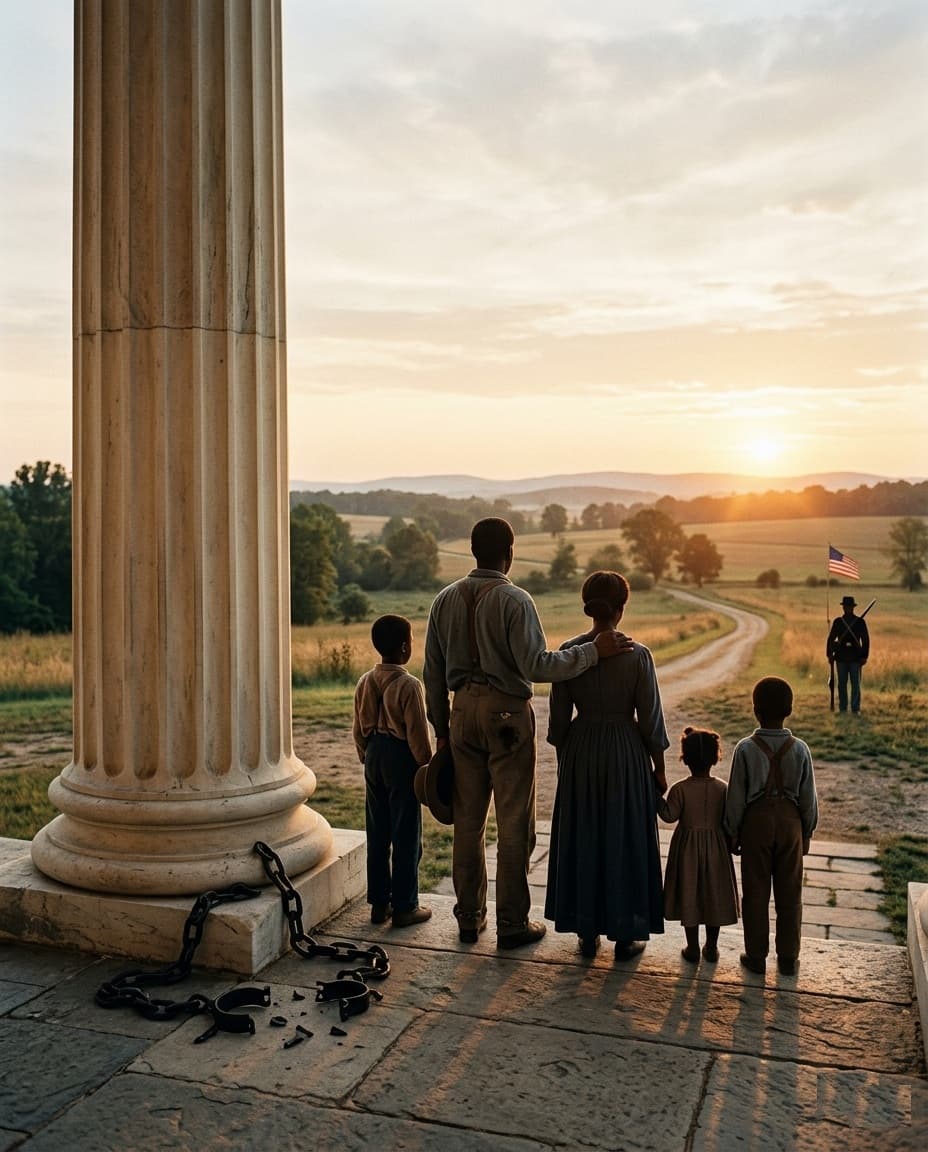
But the Emancipation Proclamation transformed the war. It made the destruction of slavery an explicit Union war aim. It invited formerly enslaved people to serve in the Union Army, eventually resulting in nearly 180,000 Black soldiersserving under the Union flag. It signaled to European powers — particularly Britain and France, whose governments had some sympathy for the Confederacy — that supporting the South now meant supporting slavery against freedom. And it committed the United States to a future in which reunion could not mean the restoration of bondage.
Lincoln knew the proclamation was not a permanent solution. He worked energetically for a constitutional amendment that would permanently abolish slavery throughout the United States, so that no future war, no future court, no future election could restore it.
Gettysburg and the Meaning of the War
In November 1863, Lincoln traveled to Gettysburg, Pennsylvania, to dedicate a military cemetery at the site of one of the war’s bloodiest battles. His remarks — fewer than 275 words — became one of the most celebrated speeches in American history.
The Gettysburg Addressredefined the meaning of the war and the meaning of the American republic. Lincoln linked the war directly to the founding promise: a nation “conceived in Liberty and dedicated to the proposition that all men are created equal” was now engaged in a great test of whether such a nation could endure.
The fallen soldiers had given their lives not merely to preserve a geographic unit, but to prove that democratic self-government was not a passing experiment. Lincoln asked the living to complete what the dead had begun: a “new birth of freedom” that would ensure government of the people, by the people, and for the people would not perish from the earth.
The phrase “new birth of freedom” is crucial. Lincoln was not arguing that the war was simply restoring the old republic. He was arguing that the war, properly understood, was moving the republic closer to what it had always claimed to be. The founding promise of equality had been partially denied by slavery. The war was the path, terrible and costly, toward fulfilling that promise.
The 13th Amendment and the End of Slavery
Lincoln’s political and moral genius was to understand that emancipation needed constitutional permanence. The Emancipation Proclamation was a wartime executive order. It could be reversed by future presidents or courts. To make abolition permanent, it had to be written into the Constitution itself.
The Thirteenth Amendment, abolishing slavery throughout the United States, passed the Senate in April 1864 and the House in January 1865. Lincoln worked intensively behind the scenes to secure the votes needed for passage. He considered it the most important achievement of his presidency.
Lincoln did not live to see its ratification. He was assassinated on April 14, 1865, just days after the Confederate surrender. But the amendment was ratified in December 1865. Slavery was no longer legal anywhere in the United States.
The Thirteenth Amendment was a constitutional revolution. For the first time, the Constitution explicitly prohibited a practice that had been embedded in the original document. It demonstrated that the American constitutional system could correct fundamental injustices through lawful constitutional action, even at the price of devastating war.
A War Unlike Most Civil Wars
The American Civil War was extraordinary in its outcome. Most civil wars in history end in one of two ways: the rebels win and establish a new regime, or the government wins and crushes the rebels without broader reform. The American Civil War ended differently.
The Union won, the Confederacy was defeated, and the nation was reunified — but reunification came alongside the abolition of slavery, the expansion of constitutional rights, and the inclusion of four million formerly enslaved people as legal persons with rights.
The war did not simply restore the old republic. It fundamentally transformed it. The three Reconstruction amendments — the 13th (abolishing slavery), the 14th (establishing birthright citizenship and equal protection), and the 15th(prohibiting denial of voting rights based on race) — remade the constitutional order. They nationalized citizenship, applied due process to state governments, and committed the republic to equal rights for all citizens.
These amendments were not fully enforced for another century. The collapse of Reconstruction, the rise of Jim Crow, and the long struggle for civil rights that followed are part of the story. But the constitutional foundation was laid. The principles were enshrined. And the Civil Rights movement of the twentieth century would eventually invoke those amendments to demand the fulfillment of promises made in the 1860s.
The Role of Soldiers and Citizens
The outcome of the Civil War was not determined by governments alone. It was determined by the choices, sacrifices, and courage of millions of individual Americans — soldiers, sailors, nurses, farmers, factory workers, abolitionists, freed people, and ordinary citizens.
Black soldiers who enlisted in the Union Army fought not only for the Union but for themselves, their families, and the meaning of freedom. Their service was a powerful argument against the claims of those who insisted they could not or would not fight for the United States.
Women organized hospitals, nursing corps, relief societies, and supply networks that sustained the Union war effort. Abolitionists who had long faced ridicule and violence for their cause lived to see their principles become national policy.
Ordinary Union soldiers — farm boys from Ohio, Irish immigrants from New York, free Black men from Massachusetts — endured unimaginable hardship out of conviction that the republic was worth saving. Their letters and diaries show men who understood, however imperfectly, that they were fighting for something larger than themselves.
Lincoln’s Second Inaugural and National Humility
On March 4, 1865, with the war nearly won, Lincoln delivered his Second Inaugural Address. Rather than claiming credit for Union victory or condemning the South, he offered one of the most remarkable reflections on national guilt and national purpose in the history of political speech.
Lincoln observed that both North and South had prayed to the same God and read the same Bible. He refused to claim that God had simply blessed the Union cause. He acknowledged that the war might be God’s punishment on the entire nation — North and South alike — for the sin of slavery. He asked Americans not to gloat but to approach reunion “with malice toward none, with charity for all.”
This posture of national humility is remarkable. A president who had just led the country through its bloodiest war declined to use victory as an occasion for self-righteousness. He acknowledged collective moral failure. He called for mercy and reconciliation alongside justice. He tied the war’s outcome not to national superiority but to moral reckoning.
Lincoln’s Second Inaugural is one of the most important texts of American exceptionalism precisely because it refuses to be smug. It holds together national purpose and national self-criticism. It calls the country not to arrogance but to honest labor.
Reconstruction and the Unfinished Work
The period after the Civil War, known as Reconstruction (1865-1877), attempted to rebuild the South on a new basis: free labor, civil rights for formerly enslaved people, and democratic participation by Black citizens. During this period, Black men voted, held public office, attended public schools, and began to build independent lives and communities.
Reconstruction ultimately failed. Southern white resistance, Northern fatigue, political compromise, Supreme Court decisions narrowing the Reconstruction amendments, and the withdrawal of federal troops in 1877 allowed the establishment of Jim Crow— a system of racial segregation, disenfranchisement, and terror that lasted nearly a century.
The failure of Reconstruction is one of the deepest tragedies in American history. The promise made to four million freed people was not kept. The constitutional amendments that were supposed to guarantee equal citizenship were systematically circumvented. The struggle for civil rights that should have been concluded in the 1860s had to be fought again in the 1950s and 1960s.
This history is essential context for understanding American exceptionalism honestly. The story is not one of unbroken progress. It is a story of founding promise, terrible failure, costly correction, continued failure, and renewed effort across generations.
Why This Matters to American Exceptionalism
The Civil War matters to American exceptionalism for several reasons.
First, it demonstrated that the founding contradiction — a republic of liberty that permitted slavery — could not survive indefinitely. The principles of the Declaration were incompatible with the institution of slavery, and the nation eventually fought a war that confirmed it.
Second, it showed that the American constitutional system could be changed through lawful processes, even when those processes required war. The Reconstruction amendments were not imposed by a dictator or a revolutionary council. They were passed by Congress and ratified by the states under the amendment process the Constitution itself prescribed.
Third, it demonstrated a form of national self-correction that is unusual in world history. Many nations have tolerated or institutionalized great injustices without ever paying a comparable price for their removal. The United States paid an enormous price. Whether that price was adequate to the wrong is a question that honest Americans continue to wrestle with. But the attempt to correct the wrong was real.
Fourth, Lincoln’s articulation of the war’s meaning — especially at Gettysburg and in his Second Inaugural — gave the country a moral vocabulary for understanding national failure and national redemption. He did not allow the Union victory to become mere nationalism. He insisted that the war meant something larger: a new birth of freedom, an honest reckoning with national sin, and a commitment to a republic more fully equal than the one that came before.
The Republic Tested and Renewed
The Civil War tested the United States more severely than any other event in its history. It revealed the depth of the nation’s founding failure. It cost more lives than any other American conflict. It nearly destroyed the republic.
Yet the republic survived. Slavery was abolished by constitutional amendment. The principle of equal citizenship was written into the foundational law. The democratic experiment continued.
That survival was not guaranteed. It required the courage and sacrifice of hundreds of thousands of soldiers, the leadership of remarkable men and women in public and private life, and the resilience of a constitutional system that, despite its failures, provided mechanisms for its own correction.
The Civil War therefore stands as evidence for both the limits and the possibilities of the American republic. Its limits: a nation that proclaimed liberty could tolerate slavery for nearly a century. Its possibilities: that same nation could, at terrible cost, change itself. That it could expand the meaning of its own founding promise. That it could use its own constitutional tools to undo one of the greatest wrongs in its history.
That capacity for self-correction — painful, slow, imperfect, costly — is one of the things that makes the American republic exceptional.
Part of the American Exceptionalism Series
View All Articles in the Series