American Exceptionalism Series · Article 4 of 8
Immigration and the Making of a Nation
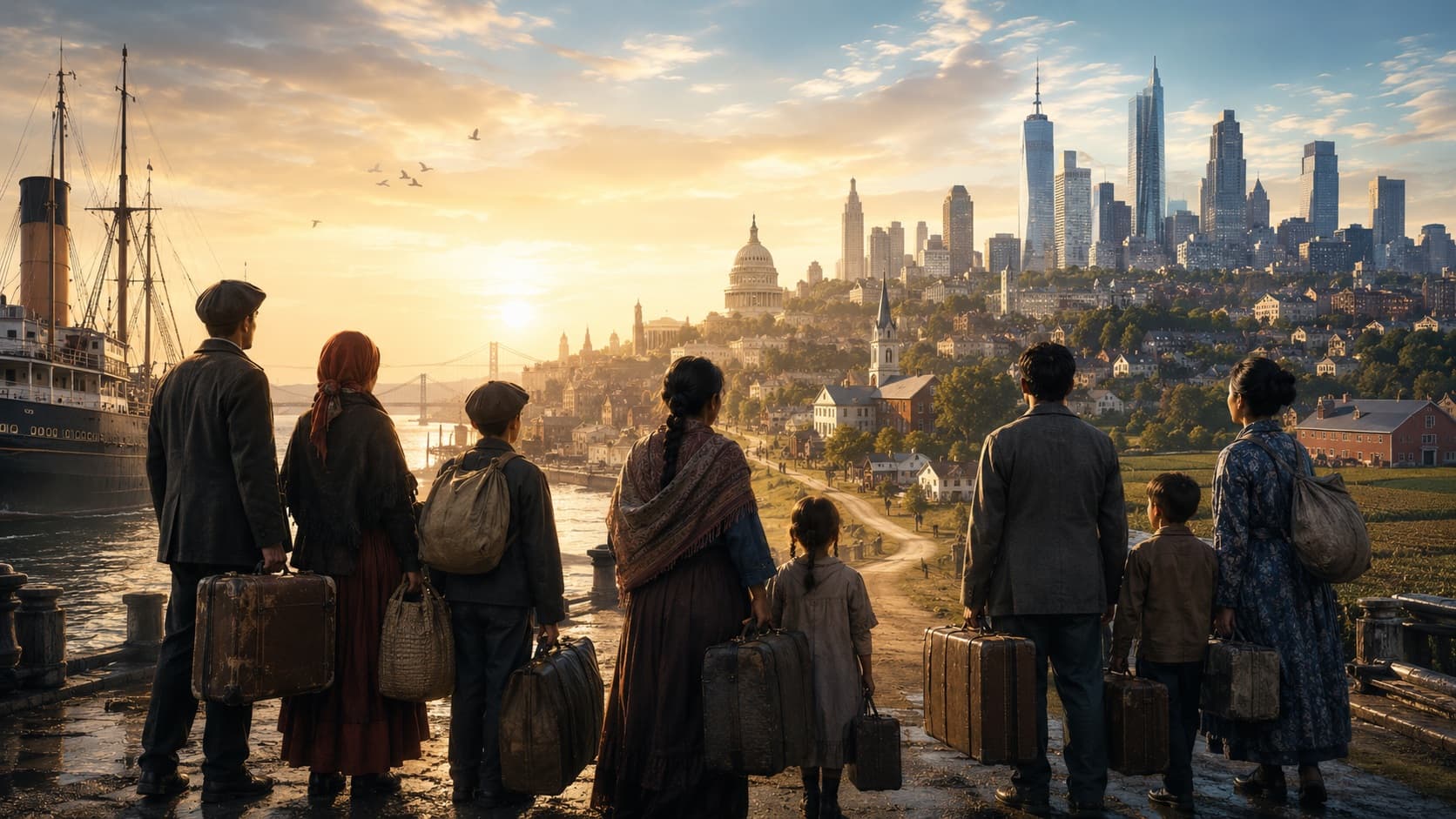
A Nation People Could Join
One of the most distinctive facts about the United States is that it has always been made, remade, and renewed by people who came from somewhere else. Most nations in world history have been built around ethnic or tribal continuity: a people already present in a land, connected by ancestry, language, and shared memory stretching back centuries. The United States was different from the start.
America was not a nation with a single ancient tribe. It was a nation built by colonists, immigrants, refugees, transported peoples, indentured servants, enslaved Africans, and all the complex interactions that followed. Before the Revolution, the American population already included English, Scots-Irish, German, Dutch, Swedish, French, African, and Indigenous peoples, with a range of languages, religions, customs, and backgrounds. After independence, the country grew through continuous immigration across two centuries.
This fact is central to American exceptionalism. A republic founded on ideas rather than blood could, in principle, extend its membership to people who shared its ideas and commitments. A person did not need to descend from a particular family or ethnic group to become American. One needed to embrace the responsibilities and liberties of American citizenship.
That principle has been contested throughout American history, and the practice has often fallen short of the ideal. But the ideal itself is exceptional: America was a nation people could join.
The Founding Ideal and the Question of Belonging
The Declaration of Independence’s language of universal rights created a tension from the very beginning. If all men were created equal and endowed with unalienable rights, who qualified for full membership in the American republic?
The founding generation gave incomplete answers. The Constitution contained the three-fifths compromise, counted enslaved people as less than full persons for apportionment purposes, and did not immediately end the Atlantic slave trade. Women were excluded from voting. Native peoples were often treated as foreign nations within the continent. Free Black citizens faced legal and social barriers even in northern states.
Yet the founding documents created a standard that future generations would use to demand expansion. The same language that said all men are created equal eventually became the argument for abolition, women’s suffrage, civil rights, and equal protection under law. Immigration’s role in this story is important: as new groups arrived, they both challenged and reinforced the question of who truly belonged in the American republic.
Each major wave of immigration forced the country to confront its founding ideals. Did the Declaration apply to Irish Catholics? To Chinese laborers? To Eastern European Jews? To Mexican workers? The long answer that American history gave was contested, uneven, often painful, and ultimately expansive.
Waves of Arrival
American immigration history can be understood in broad waves, each of which transformed the nation’s culture, economy, religion, politics, and identity.
The colonial era brought English settlers, Scots-Irish Presbyterians, German Lutherans and Pietists, Dutch Reformed communities, French Huguenots, and Sephardic Jews, alongside the forced migration of hundreds of thousands of enslaved Africans. By the time of the Revolution, the English were a plurality but not an overwhelming majority.
The early national period(1790s–1830s) saw relatively modest immigration, but the Irish and Germans began arriving in larger numbers. The Irish potato famine (1845–1852) produced one of the largest sudden migrations in American history, bringing more than a million Irish immigrants in just a few years. German political refugees came after the failed revolutions of 1848. By the 1850s, these Catholic and Lutheran newcomers were transforming cities, building churches, and entering political life.
The late nineteenth century brought a massive new wave from Southern and Eastern Europe: Italians, Poles, Russians, Ukrainians, Czechs, Slovaks, Hungarians, Greeks, and Jews fleeing persecution in the Russian Empire and elsewhere. This period also saw significant Chinese immigration to the West Coast, often brought as labor for railroads and mining, until the Chinese Exclusion Actof 1882 barred further entry from China — one of the most explicitly discriminatory laws in American immigration history.
The twentieth century brought successive waves from Mexico, the Caribbean, Central America, South America, the Philippines, Korea, Vietnam, South Asia, East Africa, the Middle East, and dozens of other nations. The Immigration and Nationality Act of 1965 abolished the national-origin quota system and opened America to a far more diverse global immigration stream.
Ellis Island and the Symbol of Hope
Between 1892 and 1954, more than twelve million immigrants passed through Ellis Islandin New York Harbor. The station became the great symbol of American immigration — the place where millions of families began their American story.
Immigrants arriving at Ellis Island went through medical inspections, interviews, and paperwork. Many had traveled for weeks in steerage conditions. Some were turned away for illness or legal complications. Most passed through. They emerged into America with little more than what they had carried, often without knowledge of English, unfamiliar with American customs, and entirely dependent on relatives, ethnic communities, and their own labor.
The stories that accumulated from Ellis Island are a major part of American memory. They include remarkable accounts of perseverance, hard work, family sacrifice, and gradual assimilation. They also include stories of exploitation, poverty, discrimination, and broken promises. Both are true. Both are part of the American immigration story.
What made Ellis Island symbolically powerful was not the ease of arrival, but the meaning of it. Immigrants came believing that America offered something the old country did not: the chance to work, build, own, educate, worship, and move without the barriers of caste, aristocracy, established church, or permanent poverty. That belief drew them. In many cases, that belief was justified.
Assimilation and the American Creed
Assimilationhas meant different things in different eras. At its most demanding, it required immigrants to abandon the language, customs, religion, and ethnic identity of their homeland and replace it with English, American manners, and civic loyalty. At its most respectful, it meant acquiring enough common ground — language, legal norms, civic habits, patriotic identification — to participate fully in American public life while retaining private cultural identity.
The tension between these visions has never been fully resolved. Americans have argued throughout their history about how much assimilation to demand, how quickly it must happen, and how much cultural pluralism a common republic can sustain.
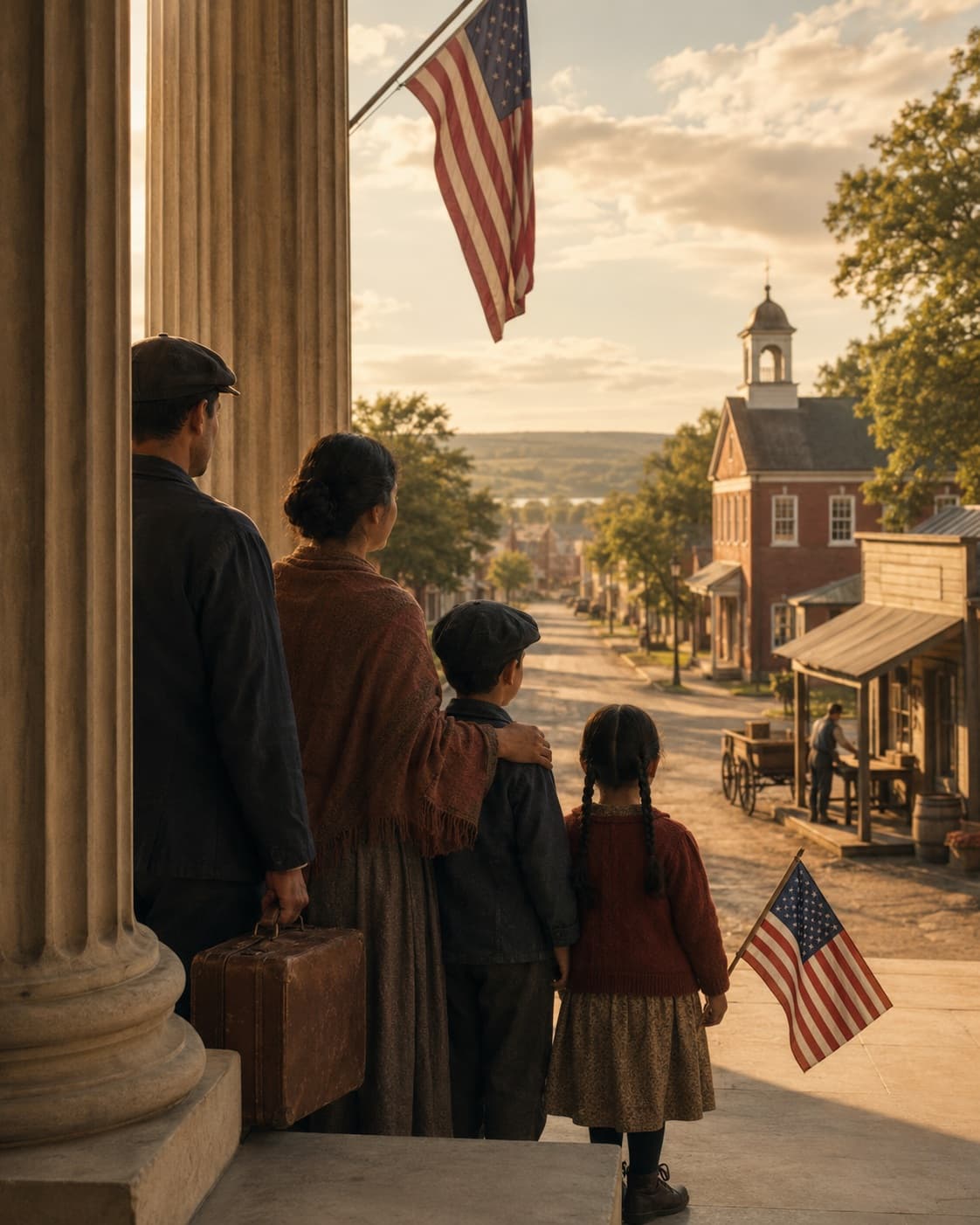
What is distinctive in the American experience is that assimilation has generally been tied to ideas rather than ancestry. To become American was not to become ethnically English or racially homogeneous. It was, at least in theory, to embrace the American Creed: the belief in liberty, equal rights, constitutional government, and the dignity of the individual citizen. This ideological standard for belonging is one of the most distinctive features of American national identity.
In practice, assimilation happened generationally. First-generation immigrants often retained their native language and customs while learning English and entering the labor market. Second-generation Americans were typically fluent in English and often experienced the pull between the old world and the new. By the third generation, families were usually fully integrated into American civic and economic life.
Schools, churches, ethnic mutual-aid societies, labor unions, political machines, and military service all played roles in assimilation. So did newspapers, popular culture, and the shared experience of economic struggle and civic participation.
Work, Enterprise, and Contribution
Immigrants shaped not only American culture but American economic growth. They built railroads, dug canals, worked mines, staffed factories, farmed land, ran small businesses, staffed hospitals, taught in schools, and founded corporations.
Immigrant labor was essential to the industrial expansionof the late nineteenth and early twentieth centuries. In cities like New York, Chicago, Pittsburgh, Detroit, and Cleveland, immigrant workers filled the factories that made America the world’s leading industrial economy. Some of that work was brutal, dangerous, and poorly paid. Labor reform movements often included immigrant workers demanding better conditions and fairer wages.
Immigrant entrepreneurship was also significant. Corner stores, tailor shops, restaurants, bakeries, and small workshops were often immigrant enterprises. Over time, immigrant-founded businesses grew into large companies. Some of America’s most consequential companies and innovations came from immigrants or their children.
This pattern has continued into the modern era. Research shows that immigrants are disproportionately represented among entrepreneurs, patent holders, scientists, and engineers. The American economy has repeatedly been renewed by ambitious newcomers willing to take risks that established residents might avoid.
Military Service and National Belonging
Military service has been one of the most powerful pathways to full participation in American civic life. Immigrants and the children of immigrants have served in every American war. Their service was often a statement of belonging: they were willing to risk their lives for a country whose promise they had chosen to join.
German-Americans, Irish-Americans, and Polish-Americans fought in the Civil War. Immigrant soldiers filled the ranks in both World Wars. Japanese-Americans, even while their families were unjustly interned during World War II, served with distinction in the 442nd Infantry Regiment, one of the most decorated units in American military history.
Service in uniform has often accelerated assimilation and earned the respect of the broader community. Veterans who had fought for America were harder to dismiss as foreigners. Military service gave immigrant communities a claim on American identity that was undeniable.
Nativism and the Fear of the Stranger
The story of immigration in America is not only a story of welcome. It includes repeated episodes of nativism: fear, hostility, and legal discrimination against newcomers.
Irish Catholics in the nineteenth century faced the Know-Nothing movementand widespread job discrimination. Anti-Catholic sentiment associated the Irish and Italian immigration with papal conspiracy and claimed they could never be truly American. Chinese immigrants faced racial violence, labor competition hostility, and ultimately the Chinese Exclusion Act. Jewish immigrants encountered quotas, social exclusion, and accusations of disloyalty.
The Immigration Act of 1924 imposed national-origin quotas designed explicitly to limit immigration from Southern and Eastern Europe and to virtually ban immigration from Asia. The law reflected a pseudo-scientific racism that dominated much American thought in the early twentieth century.
These episodes of nativism are part of the American story, and they cannot be minimized. They reveal a recurring tension in American life between the universalist ideals of the founding and the human fear of the unfamiliar. That tension has never been permanently resolved. It emerges in different forms in different eras.
But the historical arc is important. Over time, most of the groups that faced discrimination were gradually absorbed into the mainstream of American civic life. The barriers of earlier eras were lifted, though often slowly and incompletely. The nativist movements of the past ultimately failed to permanently exclude the newcomers. America remained, despite its failures, a place where outsiders could eventually become insiders.
Immigration, Law, and Sovereignty
A complete account of immigration and American exceptionalism must also acknowledge that control over immigration is a legitimate function of national sovereignty. No nation is required to admit all who wish to enter. Managing immigration involves questions of national security, economic capacity, social cohesion, rule of law, and fairness to those who immigrate legally.
Throughout American history, immigration policy has been a source of genuine disagreement among people of good will. How many immigrants should be admitted each year? From where? With what skills or family connections? Through what process? What obligations do immigrants accept, and what rights do they acquire?
These are legitimate policy questions without simple answers. America’s immigration policy has been changed many times and will likely be changed again. The American tradition does not require unlimited or unregulated immigration. It requires that immigration policy be debated honestly, decided through constitutional processes, and administered with respect for the human dignity of those involved.
What the American tradition does resist is permanent ethnic or racial exclusion from the possibility of citizenship. The United States has, over its history, moved away from racial and ethnic barriers to naturalization and toward a system grounded in legal process, civic commitment, and the rule of law.
A Nation Renewed Across Generations
One of the most powerful themes in immigration history is renewal. Each wave of immigration brought people who combined hunger for opportunity with willingness to work, sacrifice, and build. This combination has been one of the engines of American energy and dynamism.
Immigrant families have repeatedly demonstrated that the American promise — imperfect and contested as it is — can be made real through work and persistence. The grandchildren of immigrants who arrived penniless have often become business owners, professionals, artists, scientists, military officers, religious leaders, and citizens who contribute enormously to American civic life.
This is not only an economic story. It is a civic story. It is about people who chose to become American and, by choosing, renewed the meaning of America for everyone else. Their stories remind native-born citizens what the nation is for. They remind the country of its founding promise. They add languages, cuisines, musical traditions, religious practices, intellectual contributions, and human perspectives that have made American culture richer and more complex.
Why Immigration Matters to American Exceptionalism
Immigration matters to American exceptionalism because it demonstrates the theory of the American founding in practice. The founding claim was that America was not a nation of blood but a nation of ideas. Immigration has tested that claim continuously.
The test has been passed imperfectly but persistently. America has excluded, exploited, and mistreated immigrants. It has also welcomed, integrated, and celebrated them. Over the long arc of history, the inclusive ideal has generally prevailed over the exclusive impulse, though never without struggle.
The result is a nation that is genuinely multicultural in its demographic composition while remaining unified in its civic creed — at its best. This combination is unusual in world history. Many nations that have received immigrants have struggled to integrate them civically. Many nations that are civic in their national identity are ethnically homogeneous. America has managed, with great difficulty and many failures, to be both ethnically diverse and civically unified.
The Continuing American Invitation
The Statue of Liberty, standing in New York Harbor since 1886, bears lines from Emma Lazarus’s poem “The New Colossus”: “Give me your tired, your poor, your huddled masses yearning to breathe free.” These lines have become one of the most familiar statements of American identity.
They do not represent the full reality of American immigration policy, which has been far more complicated, selective, and sometimes cruel. But they point to something real about the American aspiration. America has long been understood — by those inside and outside its borders — as a place where life can be different, where birth does not permanently determine destiny, and where belonging is open to those who choose to join.
That invitation is part of what makes America exceptional. It is also part of what makes American citizenship serious. To join America is to join an experiment in self-government. It carries responsibilities as well as rights. It asks for civic commitment, not just economic participation.
The ongoing challenge for the American republic is to remain open enough to renew itself through immigration, principled enough to maintain the rule of law in how it manages the process, and confident enough in its own ideals to expect that newcomers will embrace them.
In that balance — open, ordered, and principled — lies something genuinely exceptional about the American experience.
Part of the American Exceptionalism Series
View All Articles in the Series