American Exceptionalism Series · Article 5 of 8
Free Enterprise, Capitalism, and the American Economy
The Economic Side of the American Experiment
American exceptionalism is not only a political story. It is also an economic story. The same principles that made the American republic distinctive in its government also shaped its economy: a belief in individual liberty, private property, voluntary exchange, and the right of ordinary citizens to work, build, invest, and improve their conditions without permission from kings, guilds, or hereditary elites.
The American economy became one of the most productive in world history. By the late nineteenth century, the United States had surpassed Britain as the world’s largest industrial economy. By the mid-twentieth century, the American economy produced roughly half of the entire world’s industrial output. That growth was not the result of natural resources alone, or of favorable geography alone, or of imperial power alone. It was the result of a distinctive combination of economic freedom, rule of law, private property, entrepreneurship, and practical innovation.
Understanding how this happened — and why it matters — is essential to understanding American exceptionalism.
Property, Work, and Independence
The American founders understood that liberty and property were deeply connected. The Declaration of Independence listed the right to pursue happiness as unalienable. The older tradition that informed the founders — drawing on John Lockeand English constitutional history — often framed this as the right to property. A person who could own land, tools, and the products of his labor was not merely a subject. He was an independent citizen.
In colonial and early national America, this connection between property and independence was not merely theoretical. Owning land meant being able to support a family without dependence on a landlord, a guild master, or a patron. It meant having standing in the community — the ability to vote, to serve on juries, to speak without fear of economic retaliation by a superior.
The American frontier made property ownership more accessible to ordinary families than in Europe, where land had long been concentrated in aristocratic estates. Free or cheap land attracted immigrants and encouraged settlement. The ability to clear land, build a farm, and leave it to one’s children became one of the core American aspirations.
This agrarian foundation shaped American economic culture. Americans valued self-reliance— the capacity to produce what one needed and to trade what one had surplus of. They valued hard work and discipline as virtues that led to independence. They were skeptical of permanent dependence on any authority, whether church, state, or aristocratic patron.
The Market as a Field of Opportunity
American economic thought from the founding era onward was shaped by a vision of the market as a place where free individuals could exchange goods, services, and labor to mutual advantage. The market was not seen primarily as a mechanism to be managed by government officials, but as an arena of voluntary cooperation in which millions of individuals made decisions about production, consumption, and investment.
Adam Smith’s Wealth of Nations, published in 1776, provided intellectual grounding for the argument that free exchange, not royal mercantilist policy, produced prosperity. The founders were familiar with Smith’s work. The idea that individual enterprise, operating under law and competition, could produce better outcomes than centralized direction became deeply embedded in American economic culture.
This did not mean that Americans rejected all government involvement in the economy. The early national government used tariffs to protect domestic industry, funded infrastructure projects like canals and post roads, and granted land to promote settlement and education. The Morrill Land-Grant Act (1862) gave states federal land to fund agricultural and mechanical colleges. The Homestead Act (1862) offered free land to settlers willing to cultivate it.
But the dominant American economic tradition emphasized that prosperity came from the decisions of millions of free individuals rather than from government command. The market was the engine. The government’s role was to secure the rule of law, enforce contracts, protect property, and maintain a framework within which enterprise could flourish.
From Farms to Factories
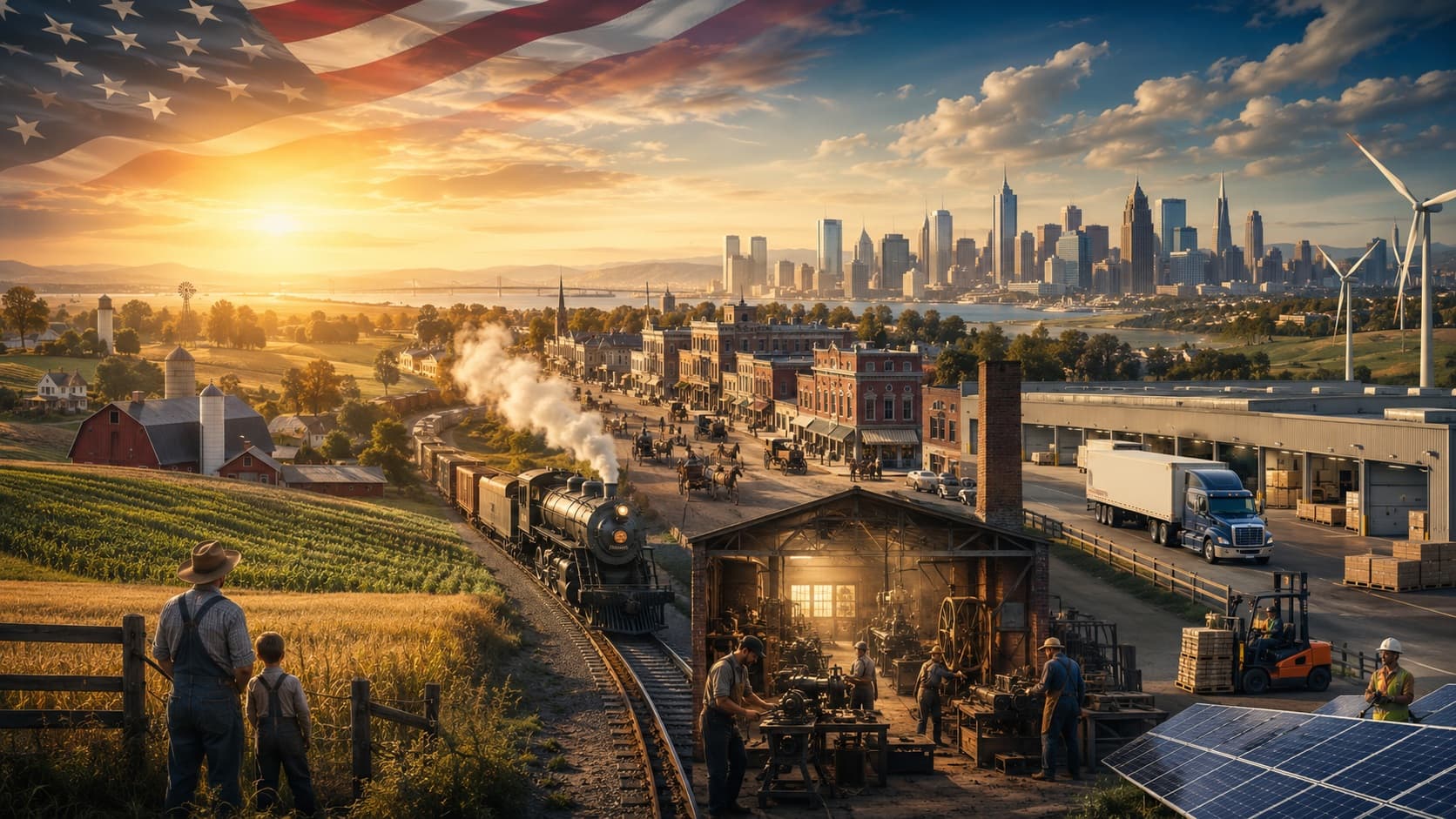
The Industrial Revolutiontransformed the American economy in the nineteenth century. What began as a largely agricultural nation became one of the world’s great industrial powers within a few generations.
American manufacturing began with textile mills in New England in the 1810s and 1820s. It spread to ironworks, steel mills, railroads, meatpacking plants, and eventually the great industries of oil, chemicals, automobiles, and electrical equipment. Cities grew rapidly as workers moved from farms to factories. Immigration provided much of the labor. Capital formation — the accumulation of savings invested in new enterprises — accelerated as banks, insurance companies, and eventually stock markets developed.
The railroad was the first great industrial system in America. The transcontinental railroad, completed in 1869, linked the Pacific and Atlantic coasts and opened the interior of the continent to settlement, agriculture, and commerce. Railways required enormous capital investment, large-scale labor organization, complex engineering, and national coordination. They were the model for the integrated industrial enterprise that would define the Gilded Age.
Andrew Carnegie in steel, John D. Rockefeller in oil, and other industrial leaders of the late nineteenth century built enterprises of unprecedented size and productivity. Their methods were often ruthless, and their power raised genuine concerns about monopoly, worker exploitation, and political corruption. But their enterprises also drove down prices, increased production, and raised the material standard of living.
The question the Industrial Age raised for American exceptionalism was whether free enterprise could remain genuinely free when some enterprises became so large that they dominated their markets, crushed competitors, and accumulated political influence matching their economic power.
Entrepreneurship and the American Character
Throughout American history, a particular kind of personality has represented the ideal of free enterprise: the entrepreneur. Not the passive investor, not the aristocratic landowner, not the government contractor — but the person who sees an opportunity, takes a risk, organizes resources, and builds something new.
American culture celebrated entrepreneurship in a way that was distinctive by international standards. The rags-to-riches narrative— the story of the self-made man or woman who rises through talent, work, and initiative — became a central American cultural myth. It was often oversimplified and used to blame poverty too quickly on personal failure. But it also captured something real about the American economic environment: that the barriers between poverty and prosperity were lower here than in many other societies.
American entrepreneurship was not only about individual success. It was about creating value for others. Entrepreneurs who succeeded did so by supplying something that customers wanted, at a price they were willing to pay, in a quantity sufficient to sustain a business. The profit motive, when operating within rule of law and honest competition, aligns personal interest with social benefit.
The cultural celebration of entrepreneurship also created a tolerance for failure that is unusual in world perspective. Americans have generally believed that business failure, if honest, should not be permanently disqualifying. Bankruptcy law allowed people to start again. Failed businesses were expected to be followed by new attempts. This tolerance for failure created an environment that encouraged risk-taking and experimentation.
Innovation, Patents, and Practical Genius
American economic growth has been closely linked to innovation. The Constitution gave Congress the power to promote science and useful arts by securing for inventors the exclusive right to their discoveries for limited periods. The patent system that followed created economic incentives for invention that were unusually accessible: a working man with a new idea could obtain legal protection for it.
American inventors became national figures. Eli Whitney’s cotton gin transformed Southern agriculture (with catastrophic consequences for slavery’s expansion). Samuel Morse’s telegraph transformed long-distance communication. Thomas Edison’s laboratory produced the incandescent light bulb, the phonograph, and the beginnings of electrical distribution systems. Alexander Graham Bell’s telephone initiated a revolution in personal communication.
What distinguished much American innovation was its practical character. American inventors were often not pure theorists but practical problem-solvers. They asked what people needed, what they could pay, and how to make it reliable enough for mass use. This practical orientation — combining technical insight with entrepreneurial vision — became one of the distinguishing features of American economic innovation.
The link between science, invention, commerce, and capital became increasingly systematic in the twentieth century. Industrial research laboratories, university research partnerships, and eventually venture capital ecosystems created infrastructure for sustained innovation that kept the American economy at or near the frontier of new technologies.
Immigration and Economic Renewal
Immigration and free enterprise have been deeply intertwined in American economic history. Immigrants arrived with skills, ambition, and willingness to work in conditions that established residents might decline. They staffed farms, mines, railroads, factories, and domestic service. They founded businesses, brought new crafts, and introduced new foods, goods, and services.
Immigrant entrepreneurship has been especially significant. Studies consistently show that immigrants are disproportionately likely to start businesses. Immigrant communities created ethnic commercial networks that served both their own communities and the broader economy. Over generations, the children and grandchildren of immigrant workers often became business owners, professionals, and contributors to the national innovation system.
In the modern era, immigrants have played a major role in the technology and biomedical industries. Many of the founders of major American technology companies were either born outside the United States or were the children of immigrants. This pattern is not accidental. People who voluntarily cross oceans and borders in search of opportunity tend to be self-selected for ambition, risk tolerance, and practical adaptability — precisely the qualities that entrepreneurship rewards.
Capitalism and the American Middle Class
Perhaps the most important measure of American free enterprise is not the wealth of the richest Americans, but the development of the American middle class. Over the course of the nineteenth and twentieth centuries, free enterprise combined with rising wages, cheap land, mass production, and economic growth to create a broad middle class that was historically unprecedented.
By the mid-twentieth century, the United States had achieved something remarkable: a majority of its citizens could afford homes, automobiles, appliances, higher education, and retirement. This was not the universal condition. Poverty persisted. Racial discrimination blocked many from sharing in prosperity. Rural areas lagged. But the general direction of American economic life in the twentieth century was the widespread distribution of prosperity to ordinary working families.
The combination of rising productivity, free labor markets, mass production (exemplified by Henry Ford’s moving assembly line and high wages policy), union organization, and competitive consumer markets drove prices down and wages up across large sectors of the economy. The result was a consumer society unlike anything in prior human history.
The Proper Role of Government
American free enterprise has never operated in a pure theoretical vacuum. Government has always played a role in the economy. The question has always been what role.
The American tradition at its best supports a government that enforces contracts, protects property rights, prevents fraud, maintains currency stability, enforces antitrust law against monopoly, builds infrastructure that private markets will not provide, and provides safety nets for those unable to participate in markets. These functions are consistent with free enterprise because they protect the framework within which markets operate honestly and competitively.
The American tradition at its best also resists a government that directly controls prices, manages production, picks economic winners, restricts entry into markets for the benefit of incumbents, or redistributes wealth primarily through command rather than through transparent taxation and democratic appropriation. These forms of intervention tend to undermine the price signals, incentives, and competition that make markets productive.
The boundary between these two roles is contested and has shifted over time. The Progressive Era, the New Deal, the Great Society, and successive periods of regulatory expansion have moved the American economy toward more government involvement. Periods of deregulation have pushed it toward more market freedom. This ongoing tension between market liberty and government action is one of the central debates of American political life.
The Dangers of Cronyism and Concentrated Power
Free enterprise can be corrupted. When businesses use government power to shelter themselves from competition — through regulatory capture, special subsidies, protective tariffs that benefit insiders at the expense of consumers, or political connections that override market discipline — the result is not free enterprise. It is cronyism.
American history includes many examples of cronyism: railroad subsidies that enriched connected investors, bank regulation written to favor established institutions, pharmaceutical pricing arrangements that limit competition, and countless examples of businesses seeking government protection from the market consequences of their own inefficiency.
The Founders worried about this danger. They associated it with the corruption of republics by factions that used public power for private advantage. An honest defense of free enterprise must include criticism of businesses that subvert market competition through political manipulation, just as it must include criticism of governments that expand control beyond what is necessary for a just and ordered economic framework.
Work, Dignity, and Responsibility
Beyond economics, the American tradition of free enterprise has always carried a moral dimension. Work is not merely a means to income. It is a source of identity, dignity, and contribution to community. The craftsman, the farmer, the merchant, the builder, the innovator — these figures have been celebrated in American culture not only because they produced wealth, but because their labor embodied virtues: discipline, skill, perseverance, and the willingness to serve others through honest trade.
The moral case for free enterprise is not simply that it produces more GDP. It is that it honors human agency. It treats people as actors capable of making decisions, taking risks, and bearing responsibility for the outcomes of their choices. It creates relationships of voluntary exchange rather than relationships of dependence and command. It allows ordinary people to build something that is genuinely their own.
This moral dimension helps explain why economic freedom and political freedom have historically been connected. A person who is entirely dependent on the state for income, housing, healthcare, and education is less free in a practical sense than a person who earns an independent living. The ability to own property, start a business, choose an employer, and move to where opportunities are best is a form of freedom that has real political consequences.
The American Economy and the World
The American economy has also shaped the world. American technology, products, business models, financial institutions, and economic ideas have spread globally. The American consumer market has been the engine that pulled the rest of the world’s exporters toward prosperity. American capital markets have funded enterprises on every continent. American universities and research centers have educated scientists, engineers, economists, and entrepreneurs from across the world.
The postwar international economic order, built largely on American initiative through institutions like the World Bank, the International Monetary Fund, and the General Agreement on Tariffs and Trade, created a framework of open trade and monetary stability that helped produce the greatest expansion of global prosperity in human history during the second half of the twentieth century.
Why Free Enterprise Matters to American Exceptionalism
Free enterprise matters to American exceptionalism because it reflects the same principle that grounds American political life: the dignity and agency of the individual person. Just as political liberty requires limiting the power of government over citizens’ choices in public life, economic liberty requires limiting the power of government over citizens’ choices in economic life.
The American experiment showed that a free economy can generate extraordinary prosperity, raise living standards for ordinary people, reward innovation, absorb immigration, and create opportunity across generations. It also showed that free enterprise requires honest institutions, rule of law, protection of property rights, resistance to cronyism, and a civic culture that values work, honesty, and responsibility.
American capitalism has not been perfect. Its history includes exploitation, inequality, financial crises, environmental damage, and the corruption of democratic processes by concentrated economic power. But the alternative to free enterprise — economies where the state directs production, sets prices, and allocates resources — has a dismal record of producing poverty, shortages, political oppression, and the destruction of human freedom.
The American economic tradition at its best combines freedom and responsibility, enterprise and accountability, competition and the rule of law. That combination is one of the reasons the American economy became a model and an engine of global prosperity. It is also one of the reasons that preserving economic liberty is essential to preserving American exceptionalism itself.
Part of the American Exceptionalism Series
View All Articles in the Series