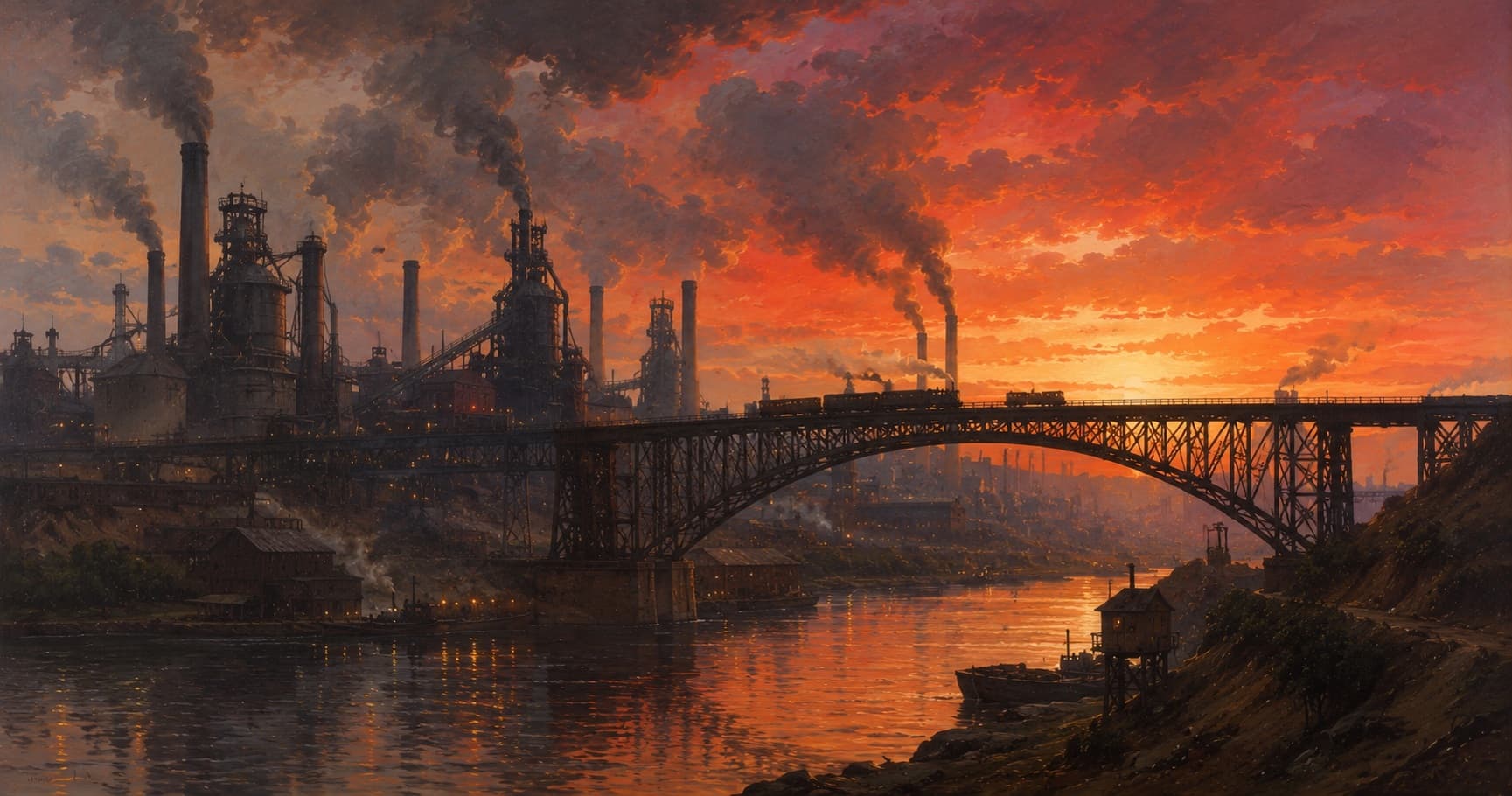
Opening Context: A Nation Transformed by Industry
Between 1877 and 1914, the United States changed from a largely rural republic into an industrial power. Railroads stretched across the continent. Steel mills, oil refineries, factories, mines, and stockyards drove economic growth. Cities expanded rapidly, and millions of immigrants arrived seeking work, safety, and opportunity. America became richer, more productive, and more influential.
Yet industrial growth brought severe challenges. Workers endured long hours, dangerous conditions, low wages, and unstable employment. Political machines controlled city life in many places. Corporate power raised questions about monopoly and fairness. In the South, Jim Crow laws imposed racial segregation and disfranchisement after Reconstruction's collapse. The era produced confidence in American energy and enterprise, but also a powerful demand for reform.
Industrial Growth and the Rise of Big Business
Industrialization rested on innovation, natural resources, transportation, and entrepreneurship. Railroads linked farms, mines, factories, and markets. Business leaders built vast corporations in steel, oil, finance, and manufacturing. Some Americans celebrated these figures as captains of industry who created jobs, lowered costs, and made the United States globally competitive. Others condemned them as robber barons who used monopoly power, political influence, and harsh labor practices to dominate the economy.
The debate over big business was not simply about wealth. It was about whether republican self-government could survive concentrated economic power. The Sherman Antitrust Act of 1890 expressed growing concern about monopolies, though early enforcement was uneven. Americans valued enterprise and property rights, but they also feared systems that seemed to deny fair competition and human dignity.
Labor conflict became a defining feature of the age. Strikes and protests reflected workers' efforts to secure better wages, shorter hours, and safer conditions. Employers often viewed unions as threats to property and order, while workers saw organization as necessary protection in an industrial economy. The tension between liberty of contract and protection from exploitation became central to reform politics.
Immigration, Cities, and Social Change
Mass immigration transformed American society. Ellis Island became a gateway for newcomers from southern and eastern Europe, while immigrants also arrived from Asia, Latin America, and other regions. They brought languages, religions, skills, family networks, and cultural traditions that enriched the nation. At the same time, they faced poverty, discrimination, crowded housing, and suspicion from native-born Americans.
Cities such as New York and Chicago became symbols of both opportunity and disorder. Skyscrapers, streetcars, department stores, settlement houses, and ethnic neighborhoods reflected urban dynamism. But tenements, disease, corruption, and crime exposed the costs of rapid growth. Reformers such as settlement workers sought to address urban poverty through education, social services, and community engagement.
The South followed a different but related path. After Reconstruction, white Southern governments built a legal system of segregation and voting restrictions. The Supreme Court's decision in Plessy v. Ferguson in 1896 upheld separate but equal doctrine, giving constitutional cover to racial segregation. Black leaders such as Booker T. Washington and W.E.B. Du Bois debated strategies for progress, education, civil rights, and resistance. Their disagreements reflected the difficult choices facing Black Americans under oppressive conditions.
Progressive Reform and National Responsibility
By the late 19th and early 20th centuries, the Progressive movement emerged to address the problems of industrial society. Progressives were diverse. Some were middle-class reformers, some were religious activists, some were journalists, some were politicians, and some were labor advocates. They sought cleaner government, safer food, regulated corporations, improved working conditions, conservation, and expanded democracy.
Theodore Roosevelt became a leading Progressive figure, arguing that government should act as a steward of the public interest. He challenged certain corporate abuses, supported conservation, and used the presidency as a platform for reform. Muckraking journalists exposed corruption, unsafe products, and social injustice.
Women's activism was central to reform. Susan B. Anthony, who died before national suffrage was achieved, helped build the movement that would eventually secure voting rights for women. Women reformers worked in temperance, education, labor protection, public health, and suffrage, often arguing that civic responsibility extended beyond the household into public life.
Contradictions and Tensions
This era celebrated freedom of enterprise but exposed the dangers of unchecked power. It welcomed immigrants into the American story while often treating them with suspicion and prejudice. It produced democratic reforms while tolerating racial disfranchisement and segregation. It expanded national wealth while leaving many workers and farmers economically vulnerable.
Progressivism itself contained contradictions. Some reforms expanded liberty and opportunity, while others reflected paternalism or prejudice. Not every Progressive trusted ordinary citizens equally. Some supported expert administration over local control. Others embraced reforms that modern Americans rightly reject. The era therefore requires careful judgment rather than simple praise or condemnation.
Legacy and Connection Forward
Industrial America built the economic foundation for the United States as a world power. Its factories, railroads, cities, and corporations transformed daily life. Its immigrants helped shape the nation's culture and labor force. Its reform movements changed expectations about what government could and should do in a modern economy.
The legacy of this era remains visible in antitrust law, labor protections, conservation, food safety, urban reform, immigration debates, and civil rights struggles. It reminds us that American capitalism has generated extraordinary innovation and prosperity, but also requires moral, legal, and civic guardrails. The challenge was not to reject enterprise, but to ensure that economic growth served a free and decent society.