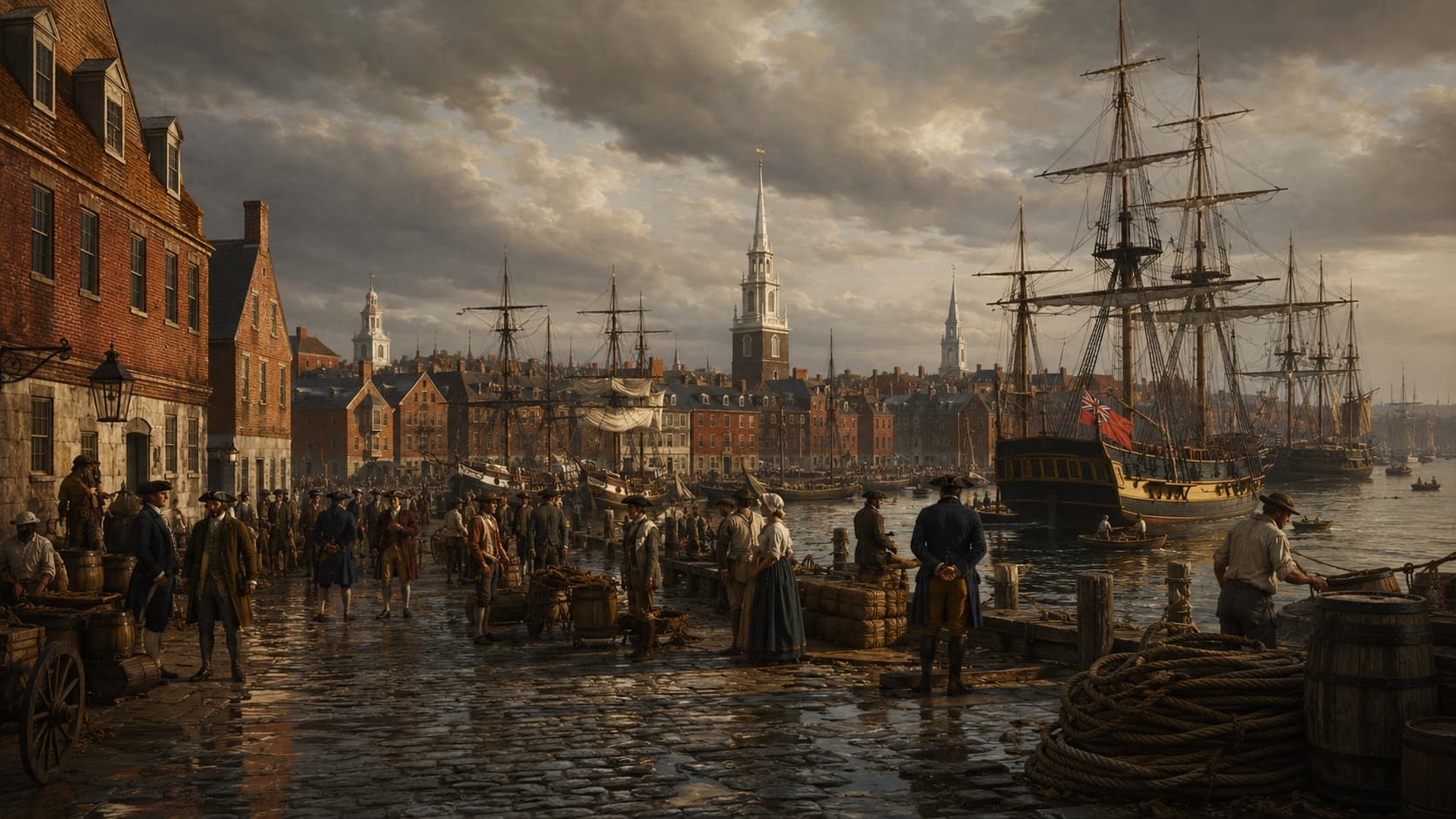
Opening Context: Colonies Becoming a People
Before Americans declared independence, they spent more than a century and a half learning how to govern themselves. The English settlements that began at Jamestown in 1607 and expanded through New England, the Middle Colonies, and the South were not founded as one nation. They were separate colonies with different religious traditions, labor systems, economies, and political habits. Yet over time, distance from Britain, frontier conditions, local assemblies, and shared struggles encouraged colonists to think of themselves as people with rights rooted not merely in royal favor, but in English constitutional tradition and, increasingly, in natural rights.
By the mid-1700s, British America was prosperous, restless, and unusually self-governing. Colonial assemblies debated taxes, roads, defense, trade, and local law. Printers circulated sermons, pamphlets, newspaper essays, and political arguments. Churches, taverns, town meetings, and colonial legislatures became schools of public life. A conservative respect for inherited liberties and local self-rule blended with Enlightenment arguments about consent, representation, and the limits of power. The road to independence was not a sudden emotional break. It was the result of long experience, growing confidence, and a constitutional dispute that Britain failed to resolve.
Imperial Crisis After the French and Indian War
The turning point came after the French and Indian War, which ended in 1763. Britain had defeated France in North America, removing a major imperial rival, but victory came at enormous cost. British officials believed the colonies should help pay for imperial defense and administration. Many colonists agreed that defense mattered, but they objected to Parliament taxing them directly without their consent. The issue was not simply money. It was authority.
The Stamp Act of 1765 required colonists to pay taxes on legal documents, newspapers, and other printed materials. Resistance spread quickly. Lawyers, merchants, printers, and ordinary citizens denounced the act as a violation of the principle that taxation required representation. Groups such as the Sons of Liberty organized protests, while colonial leaders sent delegates to the Stamp Act Congress. Britain repealed the act, but Parliament also claimed full authority over the colonies, leaving the deeper conflict unresolved.
The Townshend Acts of 1767 renewed the controversy by taxing imported goods and strengthening customs enforcement. Boycotts, public protests, and political writing grew more intense. In Boston, the presence of British troops increased tension. The Boston Massacre of 1770, in which British soldiers fired into a crowd, became a powerful symbol of imperial overreach, though the legal defense led by John Adams also demonstrated a colonial commitment to due process even in moments of anger.
From Protest to Resistance
During the early 1770s, colonial resistance became more organized and more radical. Samuel Adams and other activists helped develop committees of correspondence, which linked towns and colonies in a network of political communication. The Boston Tea Party of 1773 was a dramatic protest against the Tea Act and what colonists viewed as Parliament's attempt to force acceptance of its taxing power. Britain responded with the Coercive Acts, known in America as the Intolerable Acts, closing Boston's port and altering Massachusetts government.
These measures convinced many colonists that the issue was no longer only taxation. It was whether local self-government would survive. The First Continental Congress met in Philadelphia in 1774, bringing together leaders from different colonies to coordinate resistance. Not all delegates favored independence. Many still hoped for reconciliation on constitutional terms. But the language of rights, consent, and liberty had become central to colonial politics.
In Virginia, Patrick Henry gave voice to the growing conviction that liberty might require armed defense. In Massachusetts, confrontation came in April 1775 at Lexington and Concord, where colonial militia and British troops exchanged fire. Once blood had been shed, reconciliation became far more difficult. By early 1776, Thomas Paine's Common Sense pushed the argument further, urging Americans to see monarchy itself as incompatible with liberty and to imagine independence as both practical and morally necessary.
Contradictions and Tensions
The road to independence contained serious contradictions. Colonists spoke passionately of liberty while slavery remained deeply embedded in parts of colonial society. Many Native nations saw British and colonial disputes through the lens of their own survival, land rights, and diplomacy. Women participated in boycotts, household production, and political culture, yet formal political rights remained largely restricted to men. Colonial unity was also incomplete. Loyalists, moderates, and patriots disagreed sharply over law, order, and allegiance.
These tensions do not erase the importance of the American argument for rights. They show that the Founding generation inherited a world of limits and injustices even as it articulated principles that would later be used to challenge those very limits. The American Revolution began as a defense of constitutional liberty, but its language carried implications far beyond the immediate dispute with Parliament.
Legacy and Connection Forward
Before 1776, Americans developed habits that would shape the nation for generations: local self-government, written protest, public debate, voluntary association, and suspicion of concentrated power. The Revolution did not emerge from chaos alone. It grew from a political culture that valued law, rights, property, religion, family, community, and representative institutions.
The era's greatest legacy was the conviction that government must rest on consent and that free people have both rights and responsibilities. The colonists did not yet have a fully formed nation, but they had begun to act like one. When independence came, it rested on decades of experience in self-rule and a widening belief that liberty was not a gift from rulers, but a principle rooted in human nature and accountable government.