Opening Context: A Declaration and a War
The year 1776 marked one of the most consequential turning points in modern history. The American colonies, already at war with Britain, moved from resistance to independence. The Declaration of Independence did more than announce a political separation. It offered a moral argument: that human beings possess rights, that governments exist to secure those rights, and that a people may alter or abolish a government that becomes destructive of them.
This was a bold claim for a fragile coalition of colonies facing the most powerful empire in the world. The new United States had no established national government, no large professional army, limited money, and deep internal divisions. Yet it possessed committed leaders, local patriot networks, a cause that inspired sacrifice, and eventually foreign allies. The Revolution tested whether principles written in Philadelphia could survive battlefields, hunger, uncertainty, and political strain.
The Meaning of Independence
The Continental Congress approved independence on July 4, 1776, but the decision was neither easy nor unanimous in spirit. Many Americans feared the dangers of rebellion, while others remained loyal to the Crown. The Declaration, principally drafted by Thomas Jefferson and revised by Congress, gave the patriot cause a universal language. Its claim that all men are created equal would become a standard by which later generations judged American conduct.
At the time, independence meant more than national pride. It meant the collapse of inherited political authority and the beginning of republican self-government. Americans would no longer be subjects of a king. They would attempt to become citizens of a republic. That transformation required new state constitutions, new institutions, and new understandings of public virtue. The Revolution asked whether liberty could be ordered, lawful, and durable.
War, Endurance, and Leadership
The military struggle was long and uncertain. George Washington, appointed commander of the Continental Army, became indispensable not because he won every battle, but because he held the army and cause together through repeated hardship. Defeats in New York and other early campaigns showed the difficulty of confronting British regulars. Yet Washington's surprise victories at Trenton and Princeton restored morale when the cause seemed near collapse.
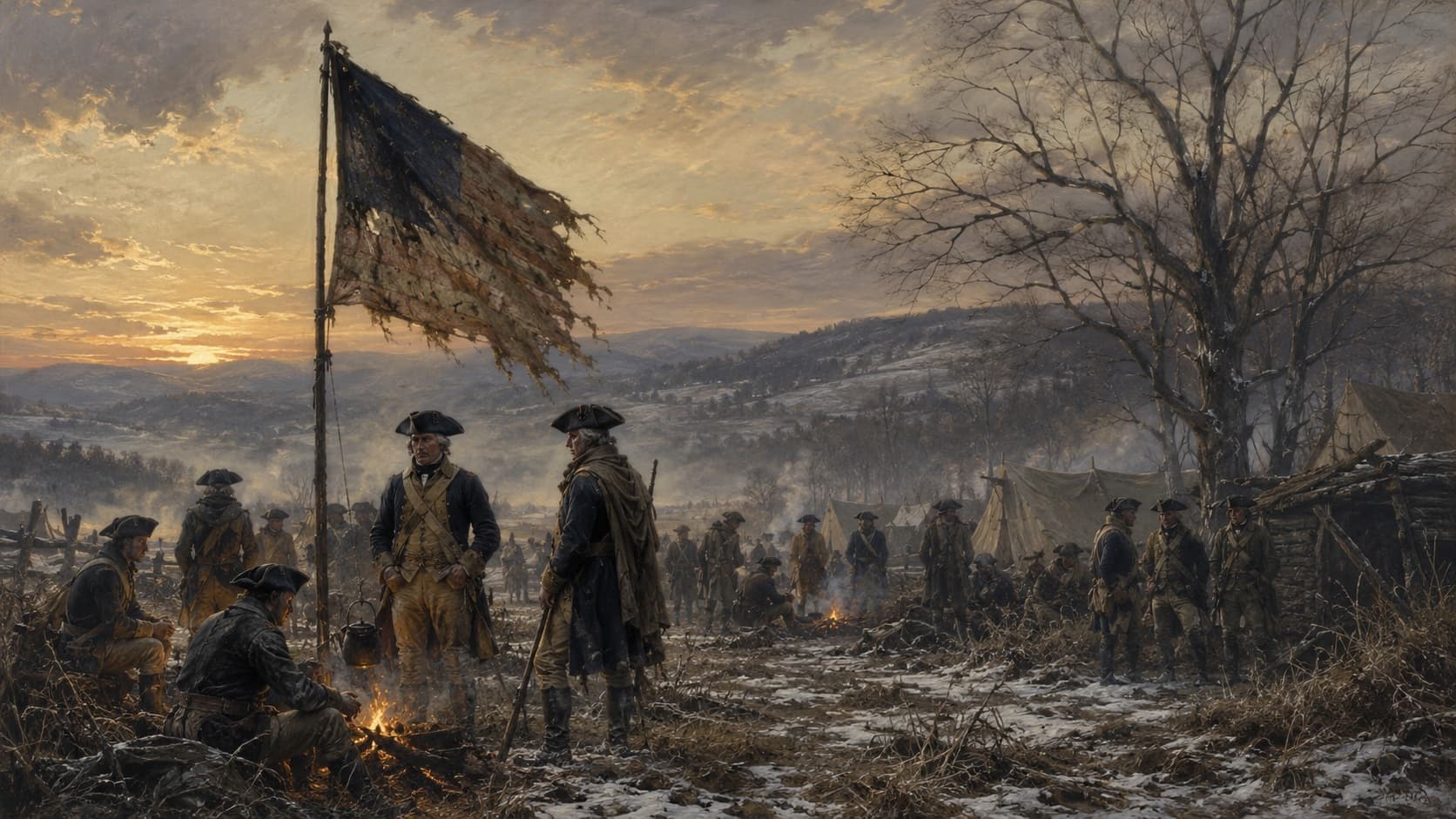
The winter at Valley Forge became a symbol of endurance. Soldiers suffered from shortages of food, clothing, and shelter, while officers struggled to impose discipline and training. The army that emerged was still imperfect, but it was more professional and more resilient. Washington's leadership combined patience, courage, restraint, and a deep understanding that the army served civilian authority.
Foreign assistance proved crucial. Benjamin Franklin helped secure French support after the American victory at Saratoga demonstrated that the patriot cause could survive. The alliance with France brought money, troops, naval power, and international legitimacy. The Marquis de Lafayette became a symbol of transatlantic commitment to liberty. At Yorktown in 1781, American and French forces trapped British General Cornwallis, leading to the decisive surrender that effectively ended major fighting.
Contradictions and Tensions
The Revolution's ideals were profound, but the new nation did not fully live up to them. Slavery remained legal in much of the country, even as enslaved and free Black Americans heard the language of liberty and applied it to their own condition. Some enslaved people sought freedom by joining British lines; others fought for the patriot cause. Native nations faced difficult choices, often viewing American expansion as a greater danger than British imperial rule.
Women contributed to the revolutionary cause through farms, households, boycotts, nursing, intelligence work, and sometimes direct support near military camps. Yet formal political citizenship remained largely male. Loyalists were often harassed, dispossessed, or forced into exile, revealing the harsh civil conflict within the Revolution itself.
There were also debates over republican virtue. Could liberty survive without moral discipline? Could local interests be balanced with national needs? Could a people suspicious of centralized power create a government strong enough to defend independence? These questions did not end with the war. They carried directly into the postwar crisis.
Legacy and Connection Forward
The Treaty of Paris of 1783 recognized American independence and gave the United States control of a vast territory stretching to the Mississippi River. Victory was extraordinary. A collection of colonies had become a sovereign nation. Yet independence was not the same as stability. The country now had to build institutions worthy of its principles.
The Revolution left Americans with a powerful inheritance: the belief that legitimate government depends on consent, that rights precede government, and that free citizens must guard liberty with vigilance. It also left unresolved contradictions that would shape future struggles over slavery, citizenship, equality, and federal power.
For America 250, this era remains central because it reminds us that the United States was born from both conviction and sacrifice. The Revolution was not inevitable, and its success was not guaranteed. It required courage, prudence, compromise, faith, and endurance. Its principles became a promise, not yet fully fulfilled, but strong enough to guide generations toward a broader understanding of American liberty.