President #4 • Democratic-Republican
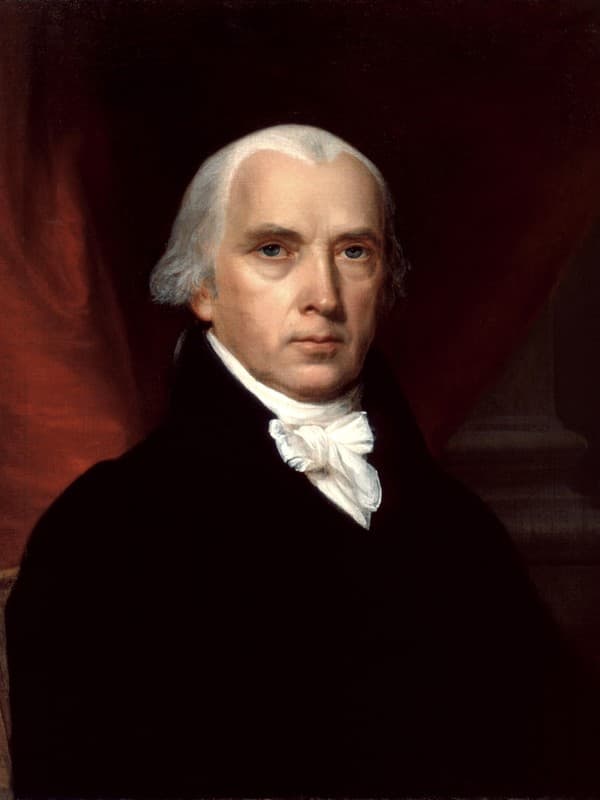
James Madison
1809–1817• 1790s–1820s: The Early Republic
James Madison was born in 1751 in Virginia and became one of the most important political thinkers of the founding era. Educated at the College of New Jersey, now Princeton, he helped design Virginia’s revolutionary government and emerged as a leading advocate for a stronger national union. At the Constitutional Convention of 1787, his Virginia Plan shaped the structure of the new federal government, and his notes remain a crucial record of the proceedings.
Madison co-authored The Federalist Papers with Alexander Hamilton and John Jay to defend ratification of the Constitution. As a member of the first Congress, he drafted the amendments that became the Bill of Rights. After serving as Thomas Jefferson’s secretary of state, he was elected president in 1808 as the Democratic-Republican successor to Jefferson.
His presidency was dominated by conflict with Britain. British interference with American trade, impressment of sailors, and frontier tensions contributed to the War of 1812. The war went badly at first, and in 1814 British forces captured and burned Washington, D.C. The successful defense of Baltimore and Andrew Jackson’s victory at New Orleans helped restore national confidence, though the Treaty of Ghent largely returned conditions to their prewar status.
Madison left office in 1817 during a period of rising national pride. In retirement at Montpelier, he helped found the University of Virginia and remained a respected constitutional elder. His intellectual contributions to the Constitution and the Bill of Rights make him among the most consequential thinkers in American history.
✓ Major Achievements
- 1Father of the Constitution — principal architect of the Constitutional Convention
- 2Drafted the Bill of Rights
- 3Co-authored The Federalist Papers
⚑ Historical Controversies
- 1War of 1812 — British burned Washington D.C. during his presidency
- 2Enslaved hundreds of people
Legacy at 250 Years
Madison's constitutional framework has governed America for 235 years — a remarkable testament to the durability of his design, and a reminder that the system's resilience depends on those who operate it with integrity.
Key Speeches & Documents
- 📜War Message to Congress (1812)
- 📜Veto Message on the National Bank (1815)
About James Madison
James Madison was a careful thinker whose work helped shape the structure of the United States government. Often called the “Father of the Constitution,” he played a leading role at the Constitutional Convention and helped explain the new system through the Federalist Papers.
As president, Madison led the country during the War of 1812, a difficult conflict that tested the young nation’s strength and independence. Although the war brought hardship, the United States emerged with a stronger sense of national identity.
Madison’s most significant achievement came before his presidency: his role in drafting and defending the Constitution and the Bill of Rights. His ideas about checks and balances, representation, and individual liberties remain part of American government today.
Historical Era
Sources & Further Reading

Ask Dr. Hart about James Madison
AI Historical Guide · America 250 Atlas
Dr. Abigail Hart can help you understand James Madison's presidency, key decisions, historical significance, and place in America's 250-year story.