President #40 • Republican
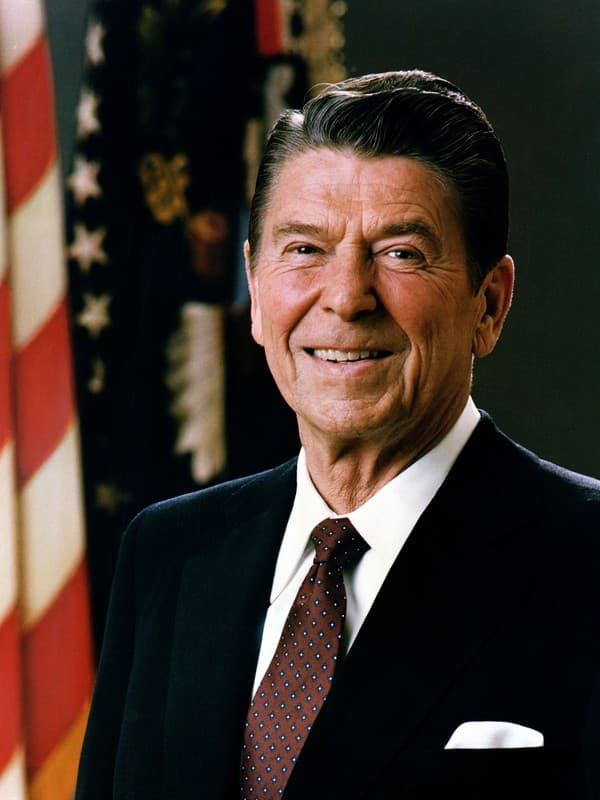
Ronald Reagan
1981–1989• 1968–2001: Modern Politics, Technology, and Globalization
Ronald Reagan was born in Illinois in 1911 and became a radio announcer, Hollywood actor, union leader, and corporate spokesman before entering politics. Originally a New Deal Democrat, he became a conservative Republican and won the California governorship in 1966. Elected president in 1980, he entered office promising lower taxes, smaller government, stronger defense, and restored national confidence after the economic and foreign policy crises of the 1970s.
Reagan’s first term reshaped domestic policy. The Economic Recovery Tax Act of 1981 cut taxes substantially, while his administration pursued deregulation, reduced some social spending, and increased defense spending. The economy suffered a deep recession early in his presidency but recovered strongly by 1984, helping Reagan win reelection in a landslide.
Foreign policy centered on confrontation with the Soviet Union, which Reagan denounced while expanding military pressure. His second term shifted toward negotiation with Soviet leader Mikhail Gorbachev, producing the 1987 Intermediate-Range Nuclear Forces Treaty. The Cold War ended shortly after Reagan left office, though historians debate how much credit belongs to Reagan, Gorbachev, internal Soviet weakness, and broader global pressures.
Reagan left office in 1989 with the Cold War winding down, the economy expanded, and American confidence restored. He died in 2004, remembered as a transformative president who renewed the nation’s sense of purpose and strength.
✓ Major Achievements
- 1Cold War victory — Soviet Union collapsed shortly after his presidency
- 2Economic expansion of the 1980s
- 3Tax Reform Act of 1986
- 4INF Treaty with Soviet Union
⚑ Historical Controversies
- 1Iran-Contra affair
- 2Response to AIDS epidemic — criticized as inadequate and discriminatory
- 3Growing income inequality under Reaganomics
- 4Support for authoritarian regimes in Latin America
Legacy at 250 Years
Reagan's vision of American optimism and strength defined the Republican Party for 40 years. At 250, debates about inequality, the role of government, and American power remain direct continuations of the Reagan era's debates.
Key Speeches & Documents
- 📜First Inaugural Address (1981)
- 📜Challenger Address (1986)
- 📜Tear Down This Wall Speech (1987)
About Ronald Reagan
Ronald Reagan was an actor, union leader, governor of California, and president who became one of the most influential political figures of the late twentieth century. His optimism and communication skills helped him connect with many Americans.
As president, Reagan promoted tax cuts, deregulation, a stronger military, and a renewed sense of national confidence. He also worked with Soviet leader Mikhail Gorbachev during a period that helped reduce Cold War tensions.
One of Reagan’s significant achievements was signing the Intermediate-Range Nuclear Forces Treaty in 1987. The agreement eliminated an entire class of nuclear missiles and marked an important step toward easing the arms race.
Historical Era
Sources & Further Reading

Ask Dr. Hart about Ronald Reagan
AI Historical Guide · America 250 Atlas
Dr. Abigail Hart can help you understand Ronald Reagan's presidency, key decisions, historical significance, and place in America's 250-year story.