President #39 • Democratic
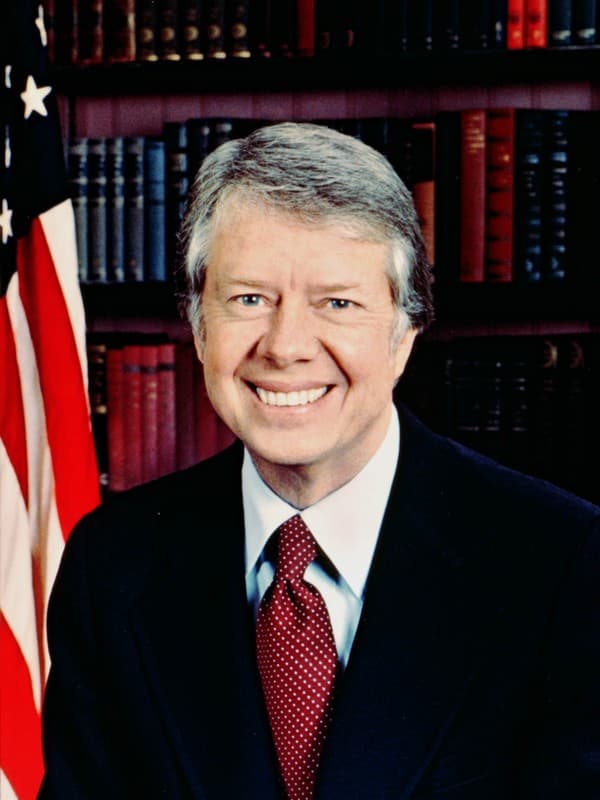
Jimmy Carter
1977–1981• 1968–2001: Modern Politics, Technology, and Globalization
Jimmy Carter was born in Plains, Georgia, in 1924 and grew up in the segregated rural South. A graduate of the U.S. Naval Academy, he served as a submarine officer before returning home to manage the family peanut business. He entered Georgia politics during the civil rights era and served as governor from 1971 to 1975. Running as an outsider after Watergate, he won the presidency in 1976 by promising honesty, human rights, and a government as good as the American people.
Carter’s domestic agenda faced severe economic difficulty. Inflation, unemployment, energy shortages, and slow growth created a sense of national frustration. He created the Department of Energy and Department of Education, promoted conservation, deregulated parts of the airline and trucking industries, and addressed the energy crisis as a long-term national challenge. His 1979 “crisis of confidence” speech identified deeper problems of trust, consumption, and civic purpose.
Foreign policy produced both major achievements and major crises. Carter brokered the Camp David Accords between Egypt and Israel, one of the most important peace agreements in modern Middle Eastern history. He made human rights a central theme of U.S. diplomacy and negotiated the Panama Canal treaties. But the Iranian Revolution and the seizure of American hostages in Tehran in 1979 overwhelmed his final year.
An attempted hostage rescue mission in 1980 was unsuccessful, and the Soviet invasion of Afghanistan ended hopes for continued détente. Carter lost the 1980 election decisively to Ronald Reagan. His post-presidency became one of the most admired in American history through election monitoring, public health work, Habitat for Humanity, conflict mediation, and human rights advocacy.
✓ Major Achievements
- 1Brokered the Camp David Accords
- 2Made human rights a central theme of U.S. foreign policy
- 3Negotiated the Panama Canal treaties
- 4Created the Department of Energy and Department of Education
- 5Built an influential humanitarian post-presidency
⚑ Historical Controversies
- 1Presided over inflation, energy shortages, and economic malaise
- 2Iran hostage crisis dominated his final year
- 3Failed hostage rescue mission damaged public confidence
- 4Soviet invasion of Afghanistan exposed limits of détente
- 5Struggled with Congress and national political communication
Legacy at 250 Years
Carter’s presidency connects America at 250 to questions of trust, human rights, energy, and moral leadership. His career shows that presidential legacy can extend beyond election results and that civic service after office can shape national memory.
Key Speeches & Documents
- 📜Inaugural Address
- 📜Crisis of Confidence Address
- 📜Camp David Accords Remarks
- 📜Farewell Address
About Jimmy Carter
Jimmy Carter came to the presidency as a former naval officer, farmer, businessman, and governor of Georgia. He presented himself as honest, thoughtful, and committed to human rights.
As president, Carter helped negotiate the Camp David Accords between Egypt and Israel, one of the most important diplomatic achievements of the late twentieth century. The agreement opened the way for a lasting peace treaty between the two countries.
Carter’s post-presidency became one of the most admired in American history. Through the Carter Center and work with Habitat for Humanity, he continued serving the public through election monitoring, disease prevention, conflict resolution, and housing efforts.
Historical Era
Sources & Further Reading

Ask Dr. Hart about Jimmy Carter
AI Historical Guide · America 250 Atlas
Dr. Abigail Hart can help you understand Jimmy Carter's presidency, key decisions, historical significance, and place in America's 250-year story.