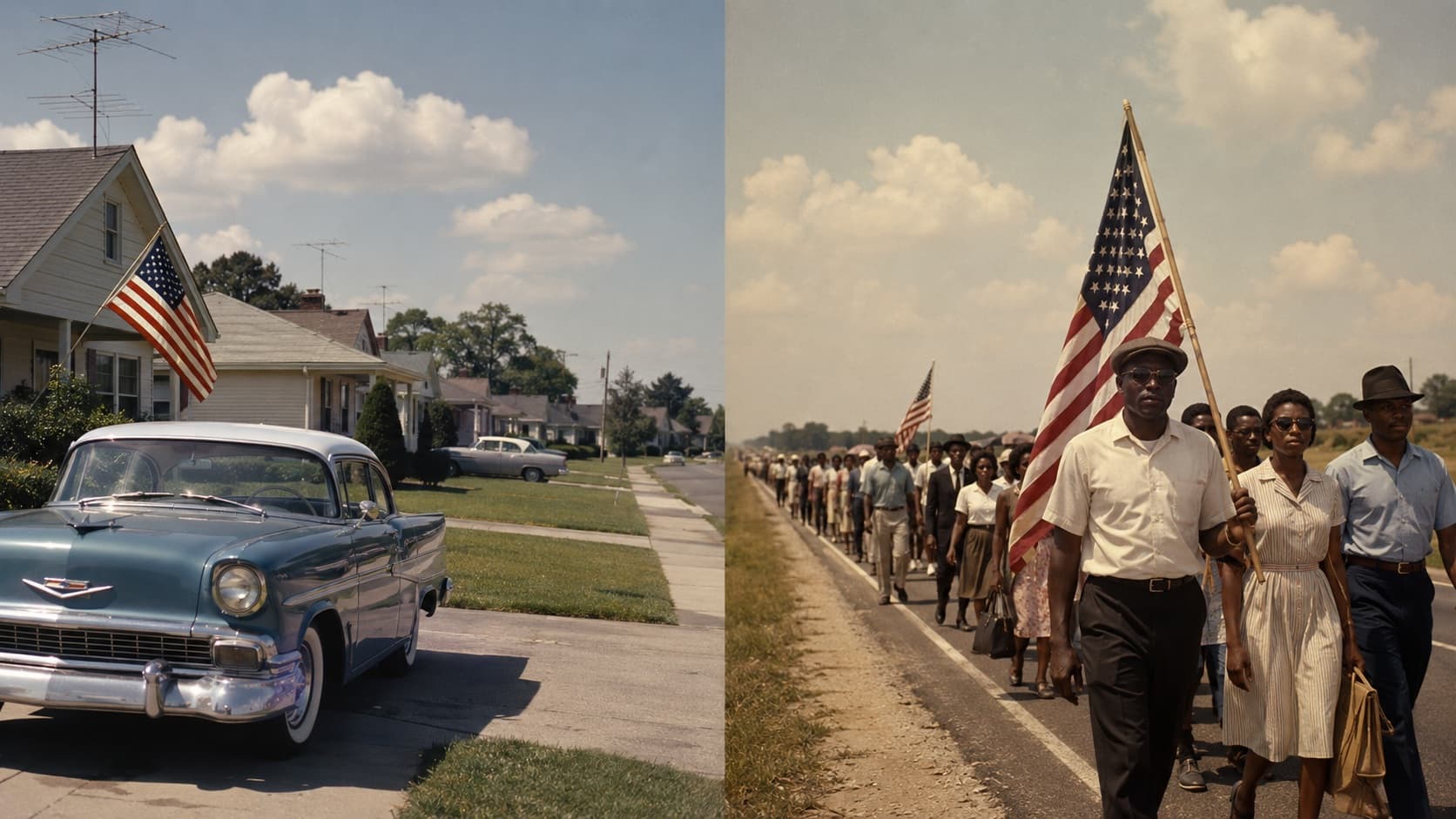
Opening Context: Power, Prosperity, and Moral Testing
After World War II, the United States emerged as one of the world's two superpowers. The other was the Soviet Union. Their rivalry, known as the Cold War, shaped foreign policy, military planning, science, culture, and domestic politics. Americans feared communist expansion, nuclear war, and ideological subversion. At the same time, the postwar economy created rising prosperity, suburban growth, and a broad middle-class ideal.
Yet the United States also faced a moral test at home. Segregation, disfranchisement, and racial discrimination contradicted the nation's claims to liberty. The civil rights movement forced America to confront this contradiction. Between 1945 and 1968, the country achieved landmark reforms, but also experienced political violence, cultural upheaval, and deep disagreement over authority, tradition, and change.
Cold War and the Free World
The Cold War began from conflicting visions of the postwar order. The United States supported constitutional democracy, market economies, and alliances among free nations. The Soviet Union imposed communist control across Eastern Europe and supported revolutionary movements elsewhere. American policy developed around containment: resisting the spread of Soviet power while avoiding direct great-power war.
This strategy shaped the Truman Doctrine, the Marshall Plan, NATO, the Korean War, and later involvement in Vietnam. The United States invested heavily in defense, intelligence, diplomacy, and technology. Nuclear weapons created a new kind of danger. Civil defense drills, fallout shelters, and arms control debates became part of American life.
The Cold War also raised concerns about civil liberties. Anti-communism was rooted in real geopolitical threats, but domestic investigations sometimes went too far, damaging reputations and narrowing debate. The challenge was to defend freedom without betraying it.
Civil Rights and Constitutional Renewal
The civil rights movement drew on churches, families, schools, courts, local organizing, and constitutional principles. In Brown v. Board of Education in 1954, the Supreme Court rejected school segregation, declaring that separate educational facilities were inherently unequal. This decision challenged the legal foundation of Jim Crow.
Activists then pushed the nation from law to action. Rosa Parks and the Montgomery Bus Boycott demonstrated the power of disciplined local protest. Martin Luther King Jr. articulated a moral vision grounded in Christian faith, constitutional ideals, and nonviolent resistance. Students staged sit-ins. Freedom Riders challenged segregated interstate travel. Marchers in Selma demanded voting rights despite violence and intimidation.
The movement achieved major legislative victories with the Civil Rights Act of 1964 and the Voting Rights Act of 1965. These laws represented a profound renewal of Reconstruction's promises. They did not create a perfect society, but they dismantled legal segregation and strengthened federal protection of civil and voting rights.
Prosperity, Space, and Cultural Change
The postwar boom changed daily life. Homeownership expanded, highways connected regions, consumer goods became more common, and higher education grew. The G.I. Bill helped many veterans build stable lives, though benefits were often administered unequally. Suburbanization reflected aspiration and family stability for many, but also contributed to racial and economic separation.
Science and technology became symbols of national strength. The Soviet launch of Sputnik shocked Americans and accelerated investment in education and space exploration. John F. Kennedy challenged the nation to reach the moon, and Cape Canaveral became a symbol of ambition and innovation. The space race was not only a scientific contest. It was a demonstration of free society's capacity for disciplined achievement.
The 1960s brought cultural change over music, religion, sexuality, education, youth authority, and the Vietnam War. Some Americans saw liberation and necessary reform. Others saw disorder, moral decline, and disrespect for institutions. Both reactions shaped modern politics.
Contradictions and Tensions
This era contained striking contradictions. The United States led the free world while denying full freedom to many citizens at home. The federal government defended democracy abroad while sometimes compromising with undemocratic allies for strategic reasons. Economic growth lifted millions, but poverty persisted in rural areas, inner cities, and minority communities.
The civil rights movement itself sparked debates over methods, pace, and goals. Nonviolent integrationism, Black nationalism, legal reform, community self-defense, and economic justice all competed for attention. The assassinations of Kennedy, King, and Robert Kennedy deepened the sense that the nation was under strain.
Legacy and Connection Forward
By 1968, America had changed profoundly. Legal segregation had been defeated, though racial inequality remained. The Cold War had become a permanent organizing force in national life. The federal government had expanded its role in civil rights, education, poverty policy, science, and defense. The culture had grown more open, but also more divided.
The legacy of this era is both inspiring and sobering. It shows that American principles can correct American failures when citizens appeal to conscience, law, and courage. It also reminds us that power abroad and justice at home must be held together. The struggle to live up to the Declaration and Constitution continued into the modern age.