President #42 • Democratic
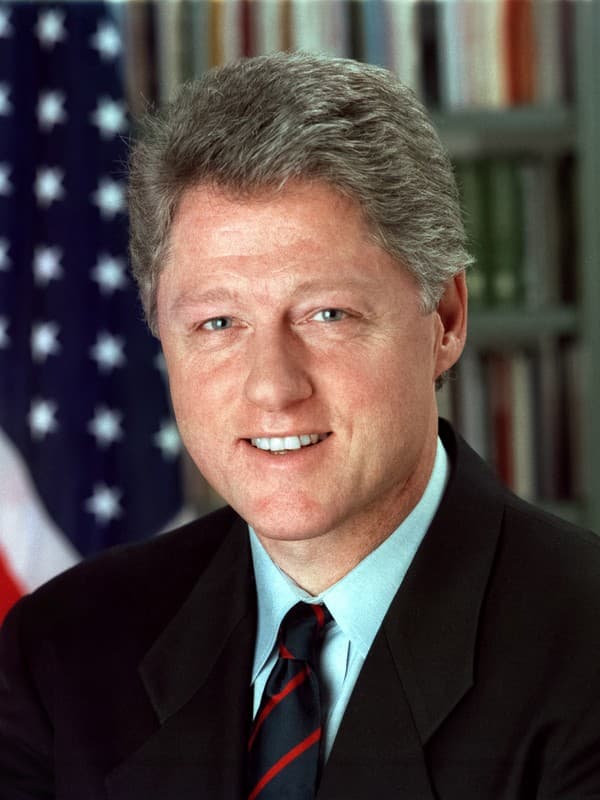
Bill Clinton
1993–2001• 1968–2001: Modern Politics, Technology, and Globalization
Bill Clinton was born in Hope, Arkansas, in 1946 and rose through education, law, and state politics. A Rhodes Scholar and Yale Law graduate, he served as Arkansas attorney general and governor before seeking the presidency as a “New Democrat.” In 1992, he defeated President George H.W. Bush and independent Ross Perot by promising economic renewal, welfare reform, middle-class opportunity, and a politics beyond old ideological divisions.
Clinton’s first term included both setbacks and major policy shifts. His health care reform effort failed, and Republicans won control of Congress in 1994. Clinton then moved toward triangulation, working with Republicans on welfare reform, deficit reduction, crime legislation, and trade. The North American Free Trade Agreement took effect during his presidency, reflecting confidence in globalization but also generating criticism over labor and manufacturing effects.
The economy became Clinton’s strongest political asset. The United States experienced low unemployment, technological growth, rising markets, and budget surpluses by the end of the decade. His administration also expanded the Earned Income Tax Credit and supported AmeriCorps. Foreign policy included intervention in the Balkans, NATO expansion, peace efforts in Northern Ireland and the Middle East, and military strikes against terrorist targets.
Clinton left office in 2001, succeeded by George W. Bush. His two terms had presided over one of the longest peacetime economic expansions in American history.
✓ Major Achievements
- 1Presided over strong economic growth and budget surpluses
- 2Expanded the Earned Income Tax Credit
- 3Created AmeriCorps
- 4Supported welfare reform and deficit reduction
- 5Led U.S. involvement in Balkan peace and NATO expansion
⚑ Historical Controversies
- 1Impeached by the House in 1998 and acquitted by the Senate in 1999
- 2Lewinsky scandal and false statements under oath damaged public trust
- 31994 crime law later criticized for contributing to mass incarceration
- 4Welfare reform criticized for weakening support for poor families
- 5NAFTA criticized for labor and manufacturing consequences
Legacy at 250 Years
Clinton’s presidency connects America at 250 to debates over globalization, economic opportunity, criminal justice, welfare, technology, and presidential accountability. His era shows how prosperity and polarization can coexist, and how personal misconduct can become a constitutional confrontation in modern politics.
Key Speeches & Documents
- 📜First Inaugural Address
- 📜1995 State of the Union Address
- 📜Remarks on Welfare Reform
- 📜Apology Address after Lewinsky Testimony
About Bill Clinton
Bill Clinton entered national politics as a former governor of Arkansas with a focus on economic opportunity, education, and practical problem-solving. He was known for strong communication skills and detailed policy knowledge.
During his presidency, the United States experienced strong economic growth, low unemployment, and budget surpluses near the end of his second term. His administration also supported welfare reform and expanded trade agreements.
One of Clinton’s significant achievements was helping produce the first federal budget surpluses in decades. His presidency reflected the optimism and technological change of the 1990s, as the internet economy began reshaping American life.
Historical Era
Sources & Further Reading

Ask Dr. Hart about Bill Clinton
AI Historical Guide · America 250 Atlas
Dr. Abigail Hart can help you understand Bill Clinton's presidency, key decisions, historical significance, and place in America's 250-year story.