President #2 • Federalist
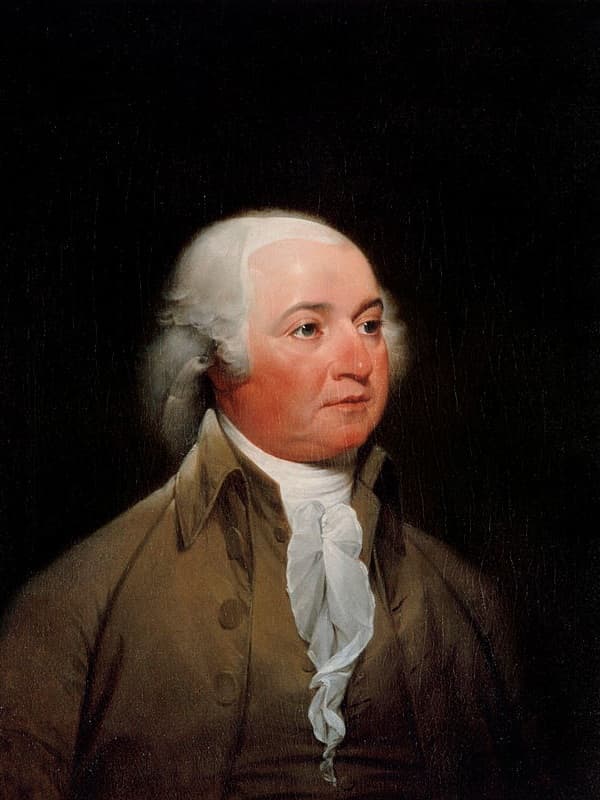
John Adams
1797–1801• 1790s–1820s: The Early Republic
John Adams was born in 1735 in Braintree, Massachusetts, and became a lawyer known for his defense of legal principle, including his representation of British soldiers after the Boston Massacre. A forceful advocate for independence, he served in the Continental Congress, helped push the colonies toward separation, signed the Declaration of Independence, and later served as a diplomat in Europe. After two terms as Washington’s vice president, he was elected the second president in 1796.
Adams inherited a volatile international situation. The French Revolution and war between France and Britain placed the United States under pressure from both powers, and the XYZ Affair led to an undeclared naval conflict with France known as the Quasi-War. Adams strengthened the navy and prepared for possible war, but he resisted pressure from many Federalists for a full military conflict.
His presidency is also remembered for the Alien and Sedition Acts of 1798. These laws addressed wartime security concerns, made it harder for potentially hostile foreign nationals to become citizens, and regulated wartime speech. They reflected the anxious environment of a young republic facing external threats.
Adams ultimately chose diplomacy with France, sending a peace mission that helped prevent a larger war. The decision divided his own party and contributed to his defeat by Thomas Jefferson in the election of 1800. Before leaving office, Adams appointed John Marshall as chief justice, a decision that shaped constitutional law for decades. He retired to Massachusetts and later reconciled with Jefferson through a famous correspondence.
✓ Major Achievements
- 1Signed the Declaration of Independence
- 2Negotiated the Treaty of Paris (1783)
- 3Kept the U.S. out of war with France
- 4Appointed John Marshall as Chief Justice
⚑ Historical Controversies
- 1Alien and Sedition Acts (1798) — severe restrictions on free speech and immigration
- 2Quasi-War with France
Legacy at 250 Years
Adams represents the fraught first decades of American democracy — a figure who stood for rule of law but signed the Alien and Sedition Acts, demonstrating that even founders could threaten the freedoms they fought to establish.
Key Speeches & Documents
- 📜Defence of the Constitutions of Government (1787)
- 📜First Inaugural Address (1797)
About John Adams
John Adams was one of the most important voices for American independence. A lawyer, diplomat, and political thinker, he helped argue the case for separation from Britain and later served as a key representative of the new nation in Europe.
As president, Adams faced a difficult international situation as the United States tried to avoid being pulled into war between Britain and France. His most significant achievement was keeping the country out of a major war with France, even when public pressure and partisan conflict made that choice politically risky.
Adams also helped define the importance of law and public service in American life. Though his presidency was often tense, his commitment to independence, diplomacy, and constitutional government made him one of the essential builders of the early republic.
Historical Era
Sources & Further Reading

Ask Dr. Hart about John Adams
AI Historical Guide · America 250 Atlas
Dr. Abigail Hart can help you understand John Adams's presidency, key decisions, historical significance, and place in America's 250-year story.