President #37 • Republican
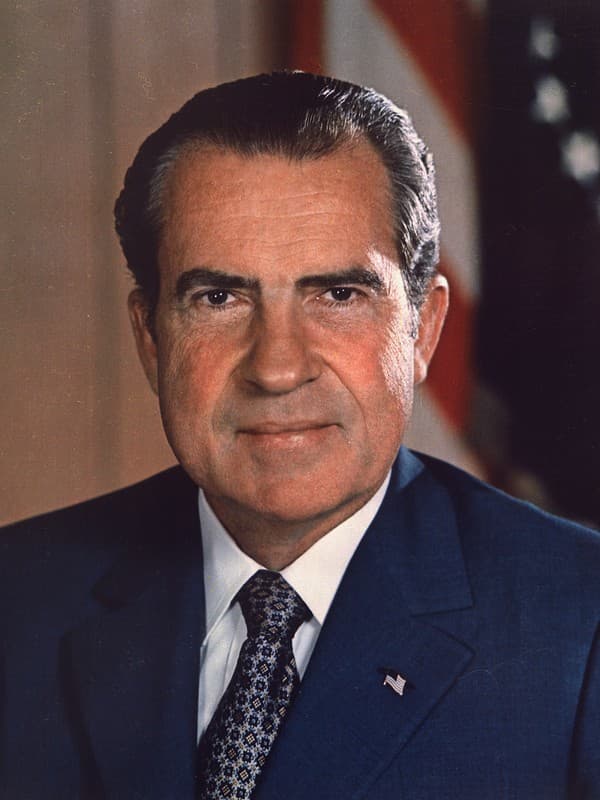
Richard Nixon
1969–1974• 1968–2001: Modern Politics, Technology, and Globalization
Richard Nixon was born in California in 1913 and built his career as an anti-communist Republican. He served in the House, Senate, and as Dwight Eisenhower’s vice president before narrowly losing the 1960 presidential election to John F. Kennedy. After losing the 1962 California governor’s race, he returned politically and won the presidency in 1968 amid war, protest, and social unrest.
Nixon’s first term combined conservative politics with major policy innovation. He pursued “Vietnamization” to reduce U.S. ground involvement in Vietnam, though he also expanded the war through secret bombing in Cambodia. His administration created the Environmental Protection Agency, supported major environmental laws, and presided over the Apollo 11 Moon landing in 1969.
His greatest foreign policy achievement was détente with communist powers. Nixon visited China in 1972, opening a new era in U.S.-China relations, and pursued arms control with the Soviet Union. The Paris Peace Accords of 1973 ended direct U.S. military involvement in Vietnam, though the war continued until the fall of Saigon in 1975.
Nixon won reelection in a landslide in 1972, but the Watergate break-in and cover-up engulfed his second term. The subsequent congressional investigations produced a constitutional crisis, and Nixon resigned on August 9, 1974, the only president to do so. Gerald Ford later pardoned him.
✓ Major Achievements
- 1Opening of diplomatic relations with China (1972)
- 2Apollo 11 moon landing (1969)
- 3Creation of the EPA (1970)
- 4Paris Peace Accords ending U.S. involvement in Vietnam (1973)
⚑ Historical Controversies
- 1Watergate scandal and cover-up
- 2Resignation from the presidency (1974)
- 3Secret bombing of Cambodia
- 4Saturday Night Massacre
Legacy at 250 Years
Watergate established the modern understanding of presidential accountability and permanently changed how Americans relate to political institutions.
Key Speeches & Documents
- 📜Resignation Address (1974)
- 📜Silent Majority Speech (1969)
About Richard Nixon
Richard Nixon had a long public career as a congressman, senator, vice president, and president. He was known for determination, knowledge of foreign policy, and a strong interest in America’s role in the world.
As president, Nixon opened diplomatic relations with the People’s Republic of China, a major shift in global politics. He also pursued arms control with the Soviet Union, including agreements that helped manage Cold War tensions.
One of Nixon’s significant achievements was the creation of the Environmental Protection Agency in 1970. Though his presidency ended in resignation after Watergate, his administration left important marks on foreign policy and environmental governance.
Historical Era
Sources & Further Reading

Ask Dr. Hart about Richard Nixon
AI Historical Guide · America 250 Atlas
Dr. Abigail Hart can help you understand Richard Nixon's presidency, key decisions, historical significance, and place in America's 250-year story.