June 11 – July 19, 2026
America at 250 and the 2026 World Cup
In the summer of 2026, the United States celebrated the 250th anniversary of the Declaration of Independence while helping welcome the world for the FIFA World Cup 2026 — a rare and exciting overlap of national milestone and global gathering.
Tournament Recap
A Record-Setting World Cup
The first 48-team World Cup delivered the largest tournament in the competition's history and finished with a new champion for the first time since 2010. Spain defeated defending champion Argentina 1–0 after extra time in the final at New York New Jersey Stadium, with Ferran Torres scoring the winner in the 106th minute.
- Champion
- Spain
- Second world title
- Attendance
- 6.8M+
- A tournament record
- Matches
- 104
- Played over 39 days
- Host Cities
- 16
- Across three countries
Final standings
Spain finished first and Argentina second. England claimed third place with a 6–4 victory over fourth-place France.
Individual honors
Spain's Rodri won the Golden Ball. France's Kylian Mbappé won the Golden Boot with 10 goals, and Spain's Unai Simón earned the Golden Glove after a record seven clean sheets.
The United States topped its group, defeated Bosnia and Herzegovina 2–0 in the round of 32, and reached the round of 16 before losing 4–1 to Belgium. Beyond the results, the event's record attendance and the successful delivery of 104 matches across a continent made the 2026 tournament a landmark success for all three host nations.
Official sources: FIFA final standings, FIFA tournament figures, and U.S. Soccer's tournament recap.
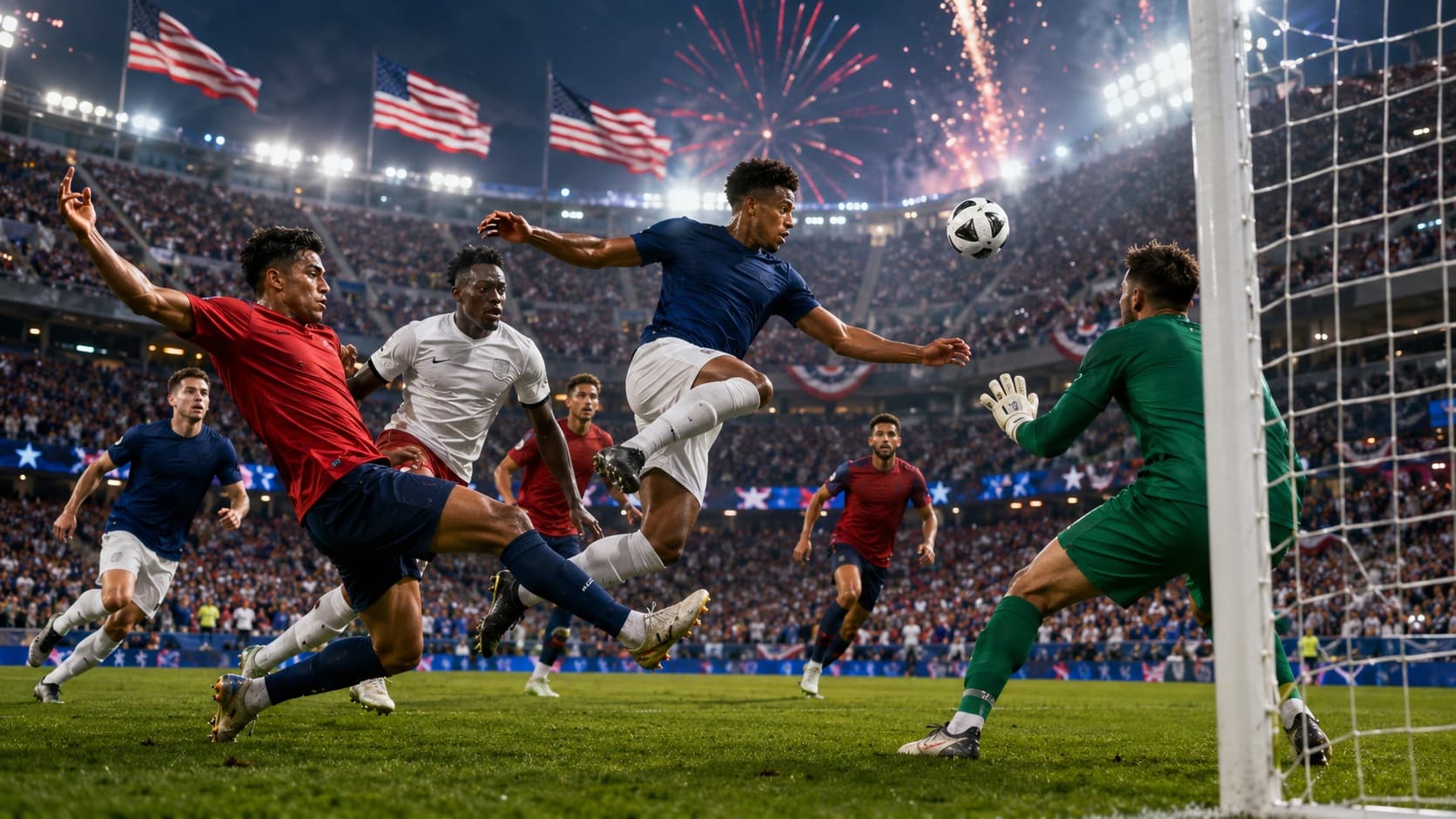
A Global Tournament in America's Anniversary Year
The 2026 World Cup ran from June 11 through July 19, 2026, placing it directly alongside America's Semiquincentennial celebration on July 4, 2026. The tournament was hosted across the United States, Canada, and Mexico, bringing teams, fans, media, and visitors from around the globe to North America.
While fireworks, parades, civic ceremonies, museum exhibits, and local commemorations marked the nation's 250th birthday, World Cup matches took place in cities across the country. Visitors came for soccer, but many also encountered the American story in the places around the matches — Philadelphia and the founding era, Boston and the Revolution, Atlanta and the Civil Rights Movement, Texas and the modern Sun Belt, California and the Pacific world, Seattle and the Northwest, and New Jersey as a gateway to one of the world's great metropolitan regions.
For America, the tournament is more than a soccer spectacle. It is a chance to show the world the variety of American life: founding cities, immigrant communities, regional traditions, modern stadiums, historic landmarks, and a republic still defined by local pride and national ideals.
The U.S. Host States
World Cup matches in the United States were played across several states, each with its own place in the American story. Some are deeply tied to the founding era. Others represent westward expansion, immigration, industry, civil rights, technology, and the growth of modern America.
| Host State | World Cup Connection | America 250 Connection |
|---|---|---|
| California | Matches in the Los Angeles area and San Francisco Bay Area | Pacific America, immigration, technology, entertainment, agriculture, and global trade |
| Florida | Matches in the Miami area | Caribbean connections, immigration, military history, space-age growth, and modern Sun Belt America |
| Georgia | Matches in Atlanta | The Revolution in the South, Civil War memory, the Civil Rights Movement, and the rise of the modern South |
| Massachusetts | Matches in the Boston area | Revolutionary America, town meetings, civic resistance, education, reform, and constitutional culture |
| Missouri | Matches in Kansas City | The frontier, westward expansion, river commerce, railroads, agriculture, and the American heartland |
| New Jersey | Matches in the New York/New Jersey area, including the final | Revolutionary crossroads, immigration gateways, industry, suburbs, and metropolitan America |
| Pennsylvania | Matches in Philadelphia | The Declaration of Independence, the Constitutional Convention, Independence Hall, and the founding of the republic |
| Texas | Matches in the Dallas and Houston areas | Frontier history, energy, space exploration, immigration, military culture, and modern growth |
| Washington | Matches in Seattle | Pacific Northwest history, trade, aviation, technology, and America's connection to the Pacific |
Why This Moment Matters
The World Cup is one of the few events that truly gathers the world's attention. For several weeks, people from different nations, languages, cultures, and traditions focus on the same tournament. In 2026, that attention turned toward North America during a milestone year for the United States.
That does not mean the World Cup becomes a history lesson. It remains, first of all, a sporting event: emotional, competitive, unpredictable, and joyful. But the setting matters. When fans walk through Philadelphia, they are near the city where American independence was declared. When they visit Boston, they are near landscapes of revolution and self-government. When they gather in Atlanta, they are in a city central to the story of civil rights and modern American growth.
America has always been both local and national. The United States is a union of states, regions, cities, towns, and communities. The World Cup gives visitors a living map of that federal republic.
Historic Places Near World Cup Host Areas
For visitors interested in America's 250th anniversary, the World Cup host areas offer many opportunities to connect the tournament with history.
Philadelphia
Independence Hall, the Declaration of Independence, the Constitutional Convention, Revolutionary War history
Boston
The Freedom Trail, Lexington and Concord, Bunker Hill, colonial resistance, early self-government
New York / New Jersey
Ellis Island, the Statue of Liberty, Federal Hall, Revolutionary War sites, immigration history
Atlanta
Martin Luther King Jr., the Civil Rights Movement, the modern South, railroad and commercial growth
Dallas and Houston
Texas history, the frontier, energy, space exploration, military and migration history
Kansas City
River commerce, railroads, jazz, agriculture, westward movement, heartland culture
Los Angeles and the San Francisco Bay Area
Pacific trade, immigration, the Gold Rush, technology, entertainment, aerospace, and cultural change
Miami
Caribbean and Latin American connections, immigration, maritime history, and modern Florida
Seattle
Pacific Northwest history, aviation, technology, trade, and America's Pacific outlook
A Celebration of Sport, Place, and People
Soccer has deep roots in immigrant communities, schools, local clubs, and youth leagues across the United States. For many Americans, the sport is tied to family heritage, neighborhood life, and connections to the wider world. The 2026 World Cup showcased that side of American culture.
It also highlighted the country's ability to host large civic and cultural events across a wide geography. Unlike a tournament centered in one city, the 2026 event stretched across a continent. Fans experienced the Atlantic coast, the Gulf coast, the Midwest, the Pacific coast, and the borderlands of North America.
That variety is part of the American story. The United States is not one landscape, one accent, one cuisine, or one historical memory. It is a nation of regions held together by constitutional ideals, shared institutions, civic habits, and a long-running argument about liberty, responsibility, opportunity, and national purpose.
Explore the Host States
Use America 250 Atlas to learn more about the states that helped host the World Cup in 2026. Each has a unique place in the American story.
One Word, Different Games
“Football” vs. “Soccer” vs. “American Football”
The meaning of football depends on where you are. The names may differ, but each term is clear once you know the regional context.
Football
Across most of the world, football means association football: the round-ball sport played at the FIFA World Cup.
Soccer
In the United States and Canada, the same World Cup sport is commonly called soccer, helping distinguish it from other football codes.
American Football
American football is the gridiron game built around downs, yards, specialized positions, and strategic offensive and defensive plays.
Learn American football by playing it
OpenPlay Football lets you run simulated drives, read defenses, and learn why different plays work through interactive, animated scenarios.