President #34 • Republican
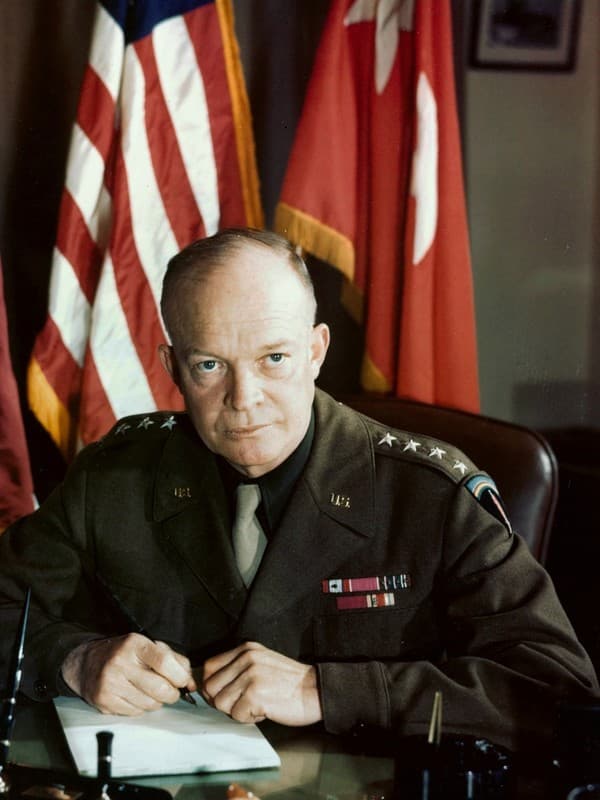
Dwight D. Eisenhower
1953–1961• 1945–1968: Cold War, Civil Rights, and Cultural Change
Dwight D. Eisenhower was born in Texas in 1890 and raised in Abilene, Kansas. A career army officer, he rose to command Allied forces in Europe during World War II and directed the D-Day invasion of Normandy in 1944. His wartime reputation made him one of the most admired Americans of his generation, and he was elected president in 1952 as a Republican promising competence, moderation, and an end to the Korean War.
Eisenhower’s first term emphasized stability at home and containment abroad. He accepted many core features of the New Deal while limiting federal expansion, and he helped negotiate an armistice in Korea in 1953. His administration relied on nuclear deterrence and covert operations as Cold War tools, including strategic intelligence operations in Iran in 1953 and Guatemala in 1954.
Domestically, Eisenhower’s most lasting achievement was the Federal-Aid Highway Act of 1956, which created the Interstate Highway System. On civil rights, he was cautious and often reluctant rhetorically, but he signed the Civil Rights Act of 1957 and sent federal troops to Little Rock, Arkansas, to enforce school desegregation after resistance to Brown v. Board of Education.
His second term faced Cold War crises, including the U-2 spy plane incident in 1960. In his Farewell Address in 1961, Eisenhower warned against the growing influence of the military-industrial complex. He retired to Gettysburg and remained a respected elder statesman until his death in 1969.
✓ Major Achievements
- 1Supreme Commander of Allied Forces in WWII (D-Day)
- 2Interstate Highway System (1956)
- 3Civil Rights Act of 1957
- 4Enforcement of school desegregation in Little Rock
⚑ Historical Controversies
- 1Initially slow public response to Brown v. Board
- 2CIA-backed coups in Iran and Guatemala
- 3U-2 spy plane incident
Legacy at 250 Years
Eisenhower’s Interstate Highway System transformed American mobility and commerce, and his Farewell Address remains one of the most prophetic warnings in presidential history.
Key Speeches & Documents
- 📜Farewell Address (1961)
- 📜Chance for Peace Speech (1953)
About Dwight D. Eisenhower
Dwight D. Eisenhower was already one of the most respected Americans before becoming president because of his leadership as Supreme Allied Commander in World War II. His calm, organized style helped guide one of the largest military coalitions in history.
As president, Eisenhower emphasized stability, moderation, and long-term national strength. He managed Cold War tensions while trying to avoid direct conflict between major powers.
One of Eisenhower’s most significant achievements was the creation of the Interstate Highway System. This massive project transformed travel, commerce, defense planning, and daily life across the United States.
Historical Era
Sources & Further Reading

Ask Dr. Hart about Dwight D. Eisenhower
AI Historical Guide · America 250 Atlas
Dr. Abigail Hart can help you understand Dwight D. Eisenhower's presidency, key decisions, historical significance, and place in America's 250-year story.