President #33 • Democratic
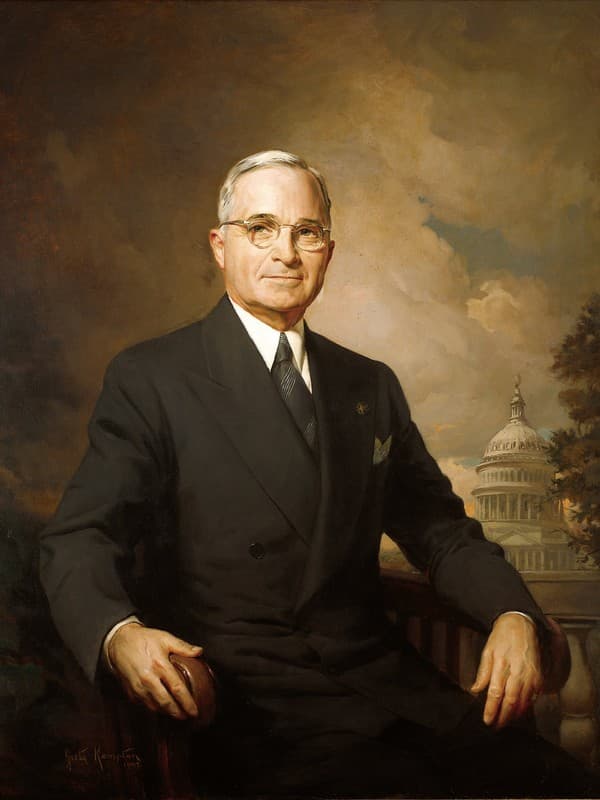
Harry S. Truman
1945–1953• 1945–1968: Cold War, Civil Rights, and Cultural Change
Harry S. Truman was born in Missouri in 1884 and worked as a farmer, soldier, businessman, county official, and U.S. senator. He served in World War I and later rose through Missouri Democratic politics. As senator, he gained respect for leading investigations into wartime spending. Franklin D. Roosevelt chose him as vice president in 1944. Truman became president on April 12, 1945, after Roosevelt died, inheriting World War II and the dawn of the atomic age.
Truman’s first months in office included Germany’s surrender and the decision to use atomic bombs against Hiroshima and Nagasaki. He defended the bombings as a way to end the war quickly and avoid invasion, while military and civilian leaders supported the decision as necessary to end the war quickly and avoid an invasion that could have cost far more lives. After Japan surrendered, Truman faced demobilization, inflation, labor unrest, and the challenge of converting from war to peace.
His presidency defined early Cold War policy. The Truman Doctrine pledged support to countries resisting communist pressure, the Marshall Plan aided European recovery, and NATO established a permanent peacetime alliance. Truman also recognized Israel, integrated the armed forces by executive order in 1948, and won a surprise election victory that year over Thomas Dewey.
His second term was dominated by the Korean War, which began in 1950 after North Korea invaded South Korea. Truman committed U.S. forces under United Nations authority but rejected General Douglas MacArthur’s push to widen the war, firing him in 1951. Truman left office in 1953 with low approval ratings, though later assessments ranked him more highly for Cold War leadership, civil rights action, and institutional decision-making.
✓ Major Achievements
- 1Led the final months of World War II
- 2Approved the Marshall Plan
- 3Established the Truman Doctrine of containment
- 4Helped create NATO
- 5Desegregated the U.S. armed forces
- 6Won the 1948 election in a major upset
⚑ Historical Controversies
- 1Authorized atomic bombings of Hiroshima and Nagasaki
- 2Korean War became unpopular and ended after he left office
- 3Fired General Douglas MacArthur during wartime controversy
- 4Loyalty and anti-communist programs raised civil liberties concerns
- 5Struggled with labor unrest and inflation after World War II
Legacy at 250 Years
Truman’s presidency connects America at 250 to the United States’ emergence as a global superpower after World War II. His record raises enduring questions about presidential power, nuclear weapons, civil rights, alliances, and the balance between security and liberty in a democratic republic.
Key Speeches & Documents
- 📜Address Announcing Japan’s Surrender
- 📜Truman Doctrine Address
- 📜1948 Civil Rights Message
- 📜Farewell Address
About Harry S. Truman
Harry S. Truman became president near the end of World War II after the death of Franklin Roosevelt. A former senator from Missouri, he was known for plain speech, decisiveness, and a strong sense of responsibility.
Truman made difficult choices in the final months of the war and then helped shape the postwar world. His administration supported the Marshall Plan, which helped rebuild Western Europe, and the Truman Doctrine, which guided American policy during the early Cold War.
One of Truman’s significant achievements was the desegregation of the United States armed forces in 1948. This executive action was an important step toward equal opportunity in national service and reflected the growing importance of civil rights in American public life.
Historical Era
Sources & Further Reading

Ask Dr. Hart about Harry S. Truman
AI Historical Guide · America 250 Atlas
Dr. Abigail Hart can help you understand Harry S. Truman's presidency, key decisions, historical significance, and place in America's 250-year story.