President #10 • Whig / Unaffiliated
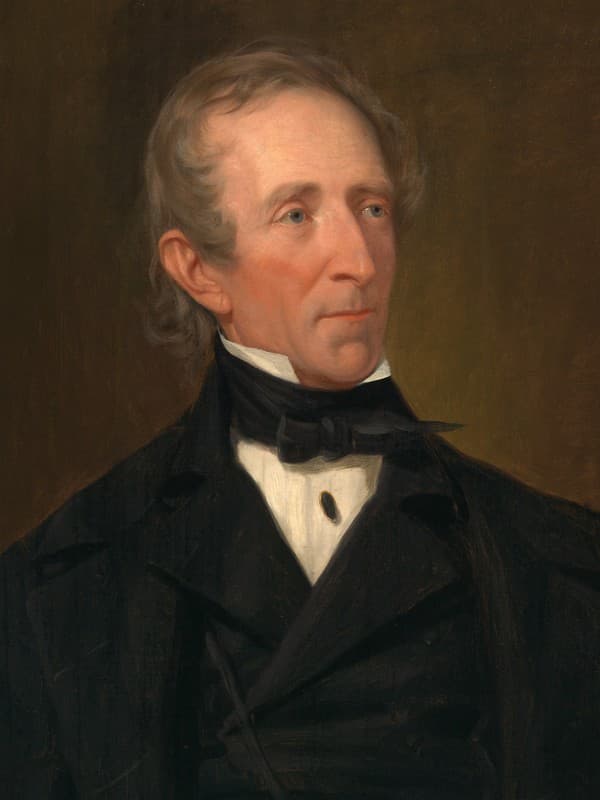
John Tyler
1841–1845• 1803–1848: Expansion, Democracy, and Conflict
John Tyler was born in Virginia in 1790 and built his career as a states’ rights politician, congressman, governor, senator, and vice president. Though elected on the Whig ticket with William Henry Harrison in 1840, Tyler had long held constitutional views closer to old Jeffersonian and states’ rights traditions. When Harrison died after only thirty-one days in office, Tyler asserted that he became the full president, establishing a crucial succession precedent.
Tyler quickly broke with the Whig Party. He vetoed major Whig banking legislation supported by Henry Clay, arguing that a new national bank was unconstitutional. Furious Whigs expelled him from the party, leaving him politically isolated. Most of his cabinet resigned, and he governed without a stable party base.
Despite political isolation, Tyler pursued an active foreign policy. His administration settled boundary tensions with Britain through the Webster-Ashburton Treaty of 1842, which clarified parts of the U.S.-Canada border and addressed other disputes. He also supported expansion into the Pacific and strengthened American interest in trade with Asia.
Tyler’s defining goal became the annexation of Texas, a slaveholding republic whose admission threatened to intensify sectional conflict and risk war with Mexico. After the Senate rejected an annexation treaty, Tyler pushed annexation through by joint resolution, signed shortly before he left office. He retired to his Virginia estate, Sherwood Forest, where he lived until his death in 1862, having established the crucial constitutional precedent of full presidential succession that would guide the republic for generations.
✓ Major Achievements
- 1Established the precedent that a vice president becomes full president upon a president’s death
- 2Negotiated the Webster-Ashburton Treaty with Britain
- 3Advanced U.S. Pacific and Asian commercial interests
- 4Completed the process leading to Texas annexation
⚑ Historical Controversies
- 1Broke with the Whig Party and governed without a party base
- 2Vetoed core Whig economic legislation
- 3Pushed Texas annexation despite its connection to slavery expansion
- 4Supported secession and the Confederacy after leaving office
- 5Enslaved people throughout his adult life
Legacy at 250 Years
Tyler’s presidency connects America at 250 to constitutional succession and the dangers of expansion tied to slavery. His career shows how decisions framed as national growth could deepen sectional division and ultimately threaten the Union itself.
Key Speeches & Documents
- 📜Address Upon Assuming the Presidency
- 📜Annual Messages to Congress
- 📜Messages on Texas annexation
About John Tyler
John Tyler became president after the death of William Henry Harrison, creating an important constitutional question: would a vice president become the full president or only act in the role? Tyler firmly claimed the full powers of the office, setting a precedent followed ever since.
His presidency was often politically difficult because he broke with many members of the party that had elected him. Even so, he worked to protect the authority of the presidency and to pursue policies he believed were constitutional.
One of Tyler’s significant achievements was helping establish the presidential succession precedent. By insisting that the vice president fully becomes president after a president’s death, he gave clarity to a process that later became essential to American stability.
Historical Era
Sources & Further Reading

Ask Dr. Hart about John Tyler
AI Historical Guide · America 250 Atlas
Dr. Abigail Hart can help you understand John Tyler's presidency, key decisions, historical significance, and place in America's 250-year story.