President #9 • Whig
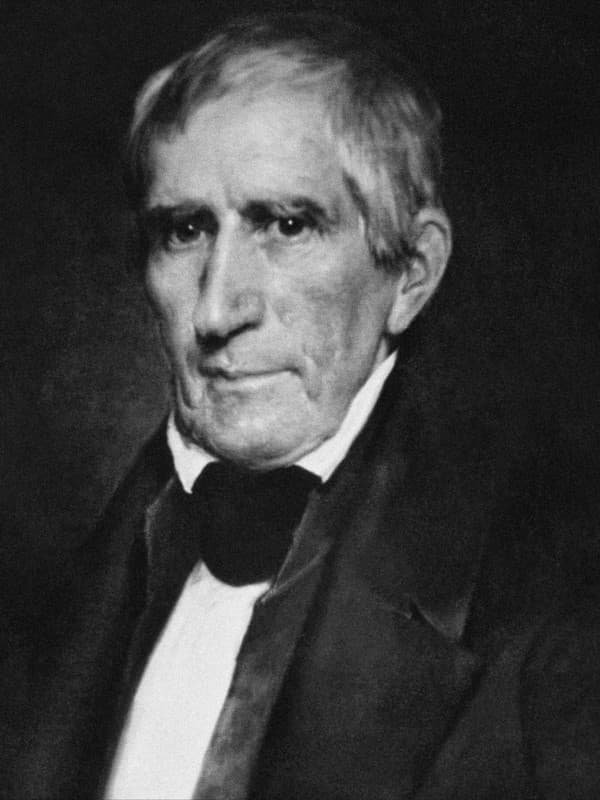
William Henry Harrison
1841• 1803–1848: Expansion, Democracy, and Conflict
William Henry Harrison was born in Virginia in 1773 into a prominent political family; his father, Benjamin Harrison V, signed the Declaration of Independence. Harrison built his career on the western frontier as an army officer, territorial governor, and politician. As governor of the Indiana Territory, he worked to open western lands to American settlement and became nationally known after the 1811 Battle of Tippecanoe, a significant engagement on the frontier.
During the War of 1812, Harrison commanded U.S. forces in the Northwest and won the Battle of the Thames in 1813, where Tecumseh was killed. These military achievements made him a symbol of frontier victory and expansion. He later served in Congress, the Ohio Senate, the U.S. Senate, and briefly as minister to Colombia.
Harrison ran unsuccessfully for president in 1836 but won in 1840 as the Whig candidate. His campaign, remembered for “log cabin and hard cider” imagery, presented him as a plainspoken frontier hero even though he came from elite origins. The Whigs used popular campaign techniques to attack Martin Van Buren over the economic depression and to mobilize voters on a national scale.
Harrison delivered a very long inaugural address on March 4, 1841, and soon fell ill. He died on April 4, only thirty-one days into his presidency, the shortest tenure in American history. His death created the first presidential succession crisis under the Constitution, resolved when Vice President John Tyler asserted that he became president, not merely acting president.
✓ Major Achievements
- 1Won national fame as a War of 1812 military commander
- 2Helped establish the Whig Party as a national electoral force
- 3His death clarified the practical importance of presidential succession
- 4Participated in the political development of the Old Northwest
⚑ Historical Controversies
- 1As territorial governor, pressured Native nations into major land cessions
- 2Built fame through campaigns tied to Indigenous dispossession
- 3Had no meaningful presidential record because he died after thirty-one days
- 4His campaign relied heavily on image-making and simplified frontier mythology
Legacy at 250 Years
Harrison’s story connects America at 250 to the frontier politics that expanded the republic while displacing Native nations. His death also highlights the importance of constitutional continuity and succession, a recurring concern in a system built around peaceful transfers of power.
Key Speeches & Documents
- 📜Inaugural Address
- 📜1840 campaign addresses
About William Henry Harrison
William Henry Harrison was best known before the presidency as a military officer and public official on the western frontier. He gained national attention for his leadership in conflicts involving Native nations and later became a symbol of frontier experience in American politics.
Harrison’s presidency was the shortest in American history, lasting only about a month. Because of that, he had little opportunity to carry out a full presidential program or leave a long record in office.
His most significant achievement came before his presidency, through decades of public service as territorial governor, military commander, congressman, senator, and diplomat. His election also showed the growing importance of popular campaigning in American presidential politics.
Historical Era
Sources & Further Reading

Ask Dr. Hart about William Henry Harrison
AI Historical Guide · America 250 Atlas
Dr. Abigail Hart can help you understand William Henry Harrison's presidency, key decisions, historical significance, and place in America's 250-year story.