President #26 • Republican
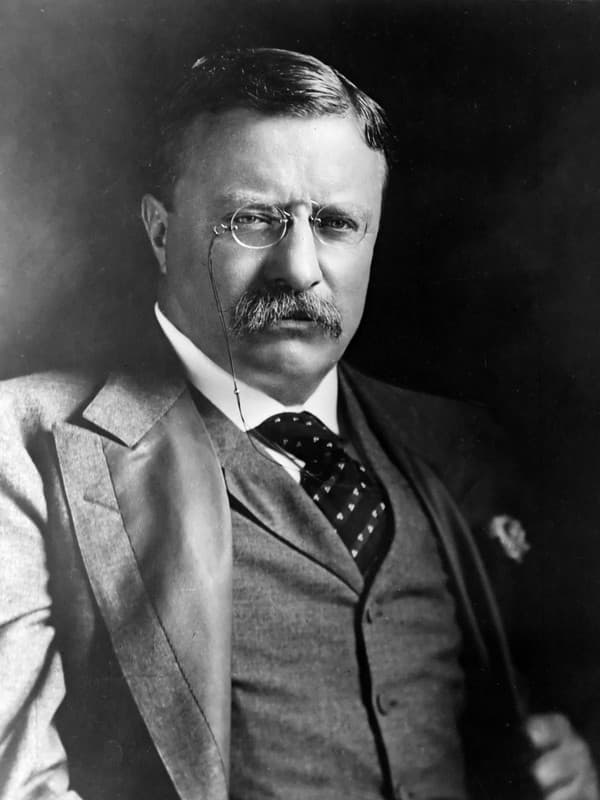
Theodore Roosevelt
1901–1909• 1877–1914: Industrial America and Reform
Theodore Roosevelt was born in New York City in 1858 to a wealthy family and overcame severe childhood asthma through physical discipline and intense ambition. He became a historian, rancher, reform politician, police commissioner, assistant secretary of the navy, and hero of the Spanish-American War. After serving as governor of New York, he became William McKinley’s vice president and then president in 1901 after McKinley’s assassination.
Roosevelt brought new energy to the office and treated the presidency as a national platform, or “bully pulpit.” His Square Deal sought to balance labor, business, and the public interest. He used the Sherman Antitrust Act against major corporations, intervened in the 1902 coal strike, and supported the Pure Food and Drug Act and Meat Inspection Act of 1906.
Conservation became one of his signature achievements. Roosevelt created or expanded national forests, parks, monuments, and wildlife refuges, preserving millions of acres of public land. In foreign policy, he backed construction of the Panama Canal, asserted American power in the Caribbean and Latin America through the Roosevelt Corollary, and won the Nobel Peace Prize for helping mediate the Russo-Japanese War.
Roosevelt left office in 1909 but remained politically restless. Dissatisfied with William Howard Taft, he ran for president in 1912 as the Progressive, or Bull Moose, candidate, splitting the Republican vote. His legacy is one of the most consequential in American history — progressive reform, conservation, and the expansion of American strength and global influence.
✓ Major Achievements
- 1Trust-busting — broke up railroad and oil monopolies under Sherman Antitrust Act
- 2Conservation — created five national parks, 18 national monuments, 150 national forests
- 3Panama Canal construction — transformed global trade
- 4Nobel Peace Prize (1906) — mediating end of Russo-Japanese War
- 5Pure Food and Drug Act and Meat Inspection Act (1906)
⚑ Historical Controversies
- 1Brownsville Affair — dishonorably discharged 167 Black soldiers on disputed evidence
- 2Imperialism in Philippines and Latin America — Platt Amendment, Roosevelt Corollary
- 3Third-party candidacy in 1912 split Republican vote and cost Taft the presidency
Legacy at 250 Years
Roosevelt's progressive vision — that government must check the excesses of unchecked corporate power while preserving the natural landscape — remains one of the most debated templates in American political life at 250 years.
Key Speeches & Documents
- 📜The Man in the Arena (1910)
- 📜The New Nationalism Speech (1910)
- 📜First Annual Message to Congress (1901)
About Theodore Roosevelt
Theodore Roosevelt brought energy, curiosity, and boldness to the presidency. Before taking office, he had been a writer, reformer, police commissioner, soldier, governor, and vice president.
As president, Roosevelt used the office as a “bully pulpit” to push for reform. He supported stronger regulation of big businesses, consumer protection, and a more active federal role in national life.
One of Roosevelt’s most significant achievements was conservation. He protected millions of acres of forests, parks, and wildlife areas, helping create a lasting national commitment to preserving America’s natural heritage.
Historical Era
Sources & Further Reading

Ask Dr. Hart about Theodore Roosevelt
AI Historical Guide · America 250 Atlas
Dr. Abigail Hart can help you understand Theodore Roosevelt's presidency, key decisions, historical significance, and place in America's 250-year story.