President #27 • Republican
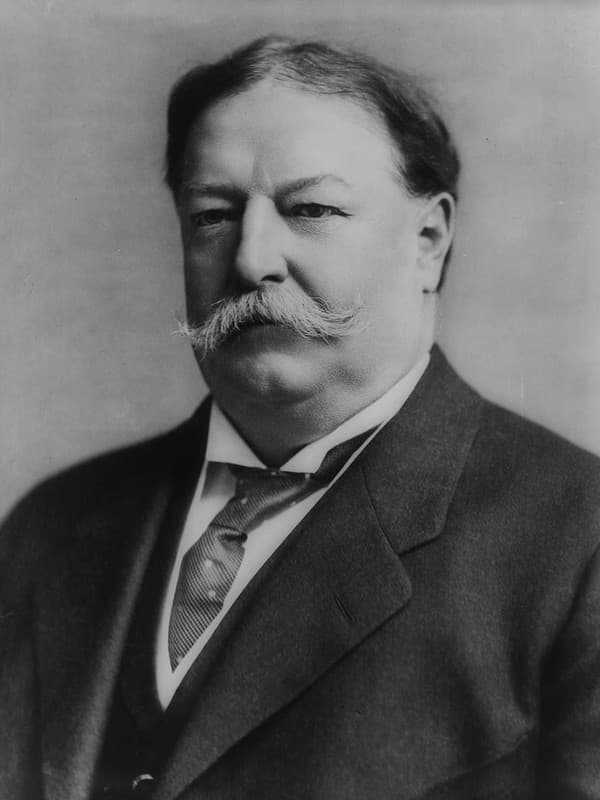
William Howard Taft
1909–1913• 1877–1914: Industrial America and Reform
William Howard Taft was born in Ohio in 1857 into a prominent political family and trained as a lawyer. He served as a judge, solicitor general, federal appellate judge, governor-general of the Philippines, and secretary of war under Theodore Roosevelt. Roosevelt supported Taft as his successor in 1908, believing he would continue progressive reform while bringing legal discipline and administrative competence to the presidency.
Taft’s domestic record was more reform-oriented than his later reputation suggested. His administration brought more antitrust suits than Roosevelt’s, supported the Mann-Elkins Act regulating railroads and telecommunications, and backed constitutional amendments authorizing a federal income tax and direct election of senators. He also expanded conservation in some areas, though disputes over public lands damaged his standing with progressives.
Foreign policy under Taft emphasized “Dollar Diplomacy,” encouraging American investment abroad, especially in Latin America and East Asia, as a tool of influence. This policy aimed to promote stability and U.S. interests but often tied American power to financial control and intervention. Taft’s approach reflected the era’s confidence in legal, economic, and administrative solutions, but also the unequal power of the United States in the hemisphere.
Taft’s presidency was ultimately split by conflict within the Republican Party. Progressives felt betrayed by his tariff policy and by the Ballinger-Pinchot conservation controversy. In 1912, a division in the Republican Party allowed Democrat Woodrow Wilson to win the presidency. Taft later achieved his lifelong ambition when President Warren Harding appointed him chief justice of the United States in 1921. He served until 1930 and remains the only person to lead both the executive and judicial branches.
✓ Major Achievements
- 1Filed major antitrust cases against large corporations
- 2Supported the Sixteenth Amendment authorizing a federal income tax
- 3Supported the Seventeenth Amendment for direct election of senators
- 4Signed the Mann-Elkins Act expanding federal regulation
- 5Later served as chief justice of the United States
⚑ Historical Controversies
- 1Split with Theodore Roosevelt and progressive Republicans
- 2Payne-Aldrich Tariff alienated reformers
- 3Ballinger-Pinchot controversy damaged his conservation reputation
- 4Dollar Diplomacy tied U.S. power to financial influence abroad
- 5Lost badly in the 1912 election after the Republican split
Legacy at 250 Years
Taft’s presidency connects America at 250 to the growth of federal regulation, constitutional reform, and the relationship between law and democracy. His career across the presidency and Supreme Court shows how American institutions evolved during the Progressive Era to manage corporate power, electoral reform, and global influence.
Key Speeches & Documents
- 📜Inaugural Address
- 📜Messages on Antitrust and Regulation
- 📜Messages on Dollar Diplomacy
- 📜Chief Justice addresses after his presidency
About William Howard Taft
William Howard Taft was a lawyer and judge at heart, with a deep respect for institutions and the rule of law. Before becoming president, he served as governor-general of the Philippines and secretary of war.
As president, Taft continued antitrust enforcement and supported efforts to make government more efficient. His style was quieter than Theodore Roosevelt’s, but he took seriously the legal responsibilities of the office.
Taft’s most unique achievement came after his presidency, when he became Chief Justice of the United States. He remains the only person to have led both the executive branch and the Supreme Court, reflecting a lifetime of service to constitutional government.
Historical Era
Sources & Further Reading

Ask Dr. Hart about William Howard Taft
AI Historical Guide · America 250 Atlas
Dr. Abigail Hart can help you understand William Howard Taft's presidency, key decisions, historical significance, and place in America's 250-year story.