President #25 • Republican
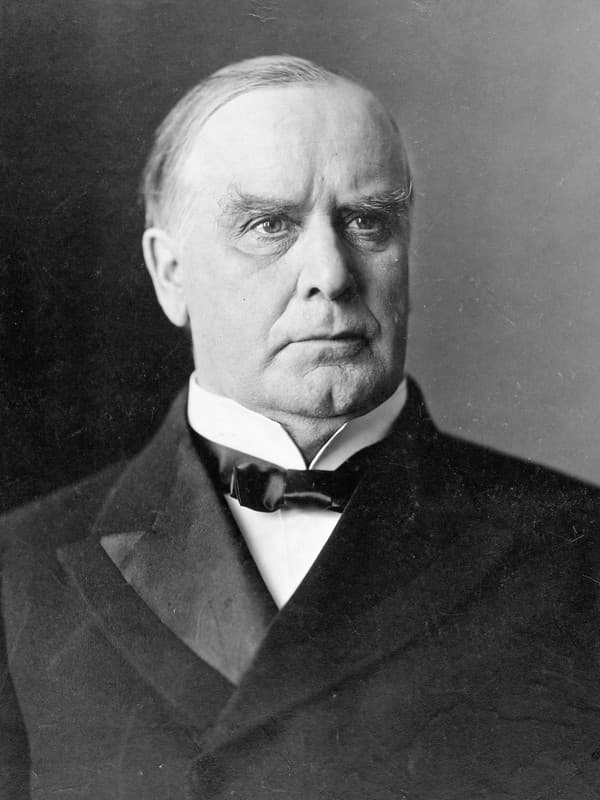
William McKinley
1897–1901• 1877–1914: Industrial America and Reform
William McKinley was born in Ohio in 1843 and served in the Union Army during the Civil War before becoming a lawyer, congressman, and governor. He became closely associated with protective tariffs and Republican economic policy. In 1896, he defeated Democrat William Jennings Bryan in an election centered on the gold standard, silver coinage, industrial capitalism, and the political power of farmers and workers.
McKinley’s first term began with economic recovery after the depression of the 1890s. He signed the Dingley Tariff, supported the gold standard, and worked closely with business-oriented Republicans. His administration marked a shift toward more modern campaign organization and national party management, aided by advisers such as Mark Hanna.
Foreign policy became the defining feature of his presidency. After conflict in Cuba and the explosion of the USS Maine, the United States went to war with Spain in 1898. The Spanish-American War was brief, but its consequences were enormous: the United States acquired Puerto Rico, Guam, and the Philippines, annexed Hawaii, and emerged as an overseas imperial power.
The Philippine-American War followed, as Filipino nationalists resisted U.S. rule. McKinley defended annexation as duty and destiny, while critics condemned imperialism and the denial of self-government. Reelected in 1900, McKinley was shot by anarchist Leon Czolgosz at the Pan-American Exposition in Buffalo in September 1901 and died days later. Theodore Roosevelt succeeded him, carrying the United States further into the Progressive and imperial era.
✓ Major Achievements
- 1Led the United States during the Spanish-American War
- 2Presided over economic recovery after the Panic of 1893
- 3Established the United States as a major overseas power
- 4Supported the Gold Standard Act
- 5Modernized national campaign organization
⚑ Historical Controversies
- 1Oversaw U.S. acquisition of overseas territories
- 2Annexed the Philippines and defended imperial rule
- 3Philippine-American War involved military campaign and denial of self-government
- 4Annexation of Hawaii followed the overthrow of the Hawaiian Kingdom
- 5Protective tariff policies favored industrial interests
Legacy at 250 Years
McKinley’s presidency connects America at 250 to the question of whether a republic founded on self-government could also become an empire. His era shows how economic power, war, race, and expansion reshaped the nation’s role in the world at the turn of the twentieth century.
Key Speeches & Documents
- 📜First Inaugural Address
- 📜War Message to Congress
- 📜Second Inaugural Address
- 📜Last Speech at Buffalo
About William McKinley
William McKinley was a Civil War veteran and longtime public servant who became president during a period of economic growth and expanding American influence. He was known for a calm manner and a close connection with voters.
As president, McKinley led the country during the Spanish-American War. The conflict was brief, but it changed the United States’ role in world affairs and brought new responsibilities overseas.
One of McKinley’s significant achievements was guiding the nation through economic recovery after the depression of the 1890s. His presidency marked a turning point as the United States became more industrial, more confident, and more involved beyond its borders.
Historical Era
Sources & Further Reading

Ask Dr. Hart about William McKinley
AI Historical Guide · America 250 Atlas
Dr. Abigail Hart can help you understand William McKinley's presidency, key decisions, historical significance, and place in America's 250-year story.