President #28 • Democratic
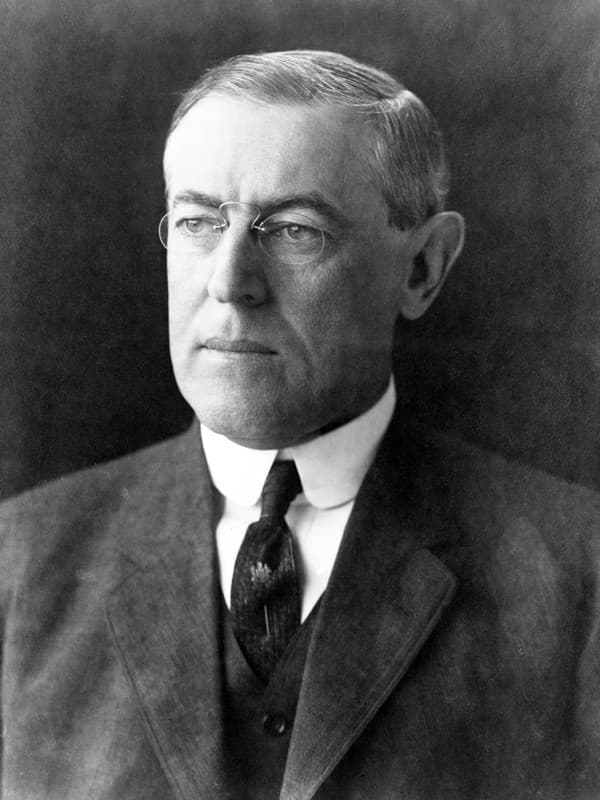
Woodrow Wilson
1913–1921• 1914–1945: World Wars and Global Power
Woodrow Wilson was born in Virginia in 1856 and grew up in the post-Civil War South. A scholar of government, he became president of Princeton University and then governor of New Jersey, where he gained a reputation as a reform Democrat. Elected president in 1912 after the Republican split between Taft and Theodore Roosevelt, Wilson entered office promising a New Freedom agenda.
His domestic program reshaped economic governance. Wilson signed the Federal Reserve Act of 1913, creating the modern central banking system, and supported the Clayton Antitrust Act and the Federal Trade Commission. During his presidency, the Sixteenth Amendment authorized the federal income tax, and the Nineteenth Amendment granting women the vote was ratified in 1920 after years of suffrage activism.
World War I transformed Wilson’s presidency. He initially pledged neutrality, but German unrestricted submarine warfare and the Zimmermann Telegram helped push the United States into war in 1917. Wilson framed the conflict as a war for democracy and later proposed the Fourteen Points, including the League of Nations, as a basis for postwar peace.
Wilson’s final years were defined by his passionate campaign for the League of Nations, a vision he believed would prevent future wars. Though the Senate rejected U.S. membership, Wilson’s idealism shaped international law and diplomacy for generations. He left office in 1921 and died in 1924.
✓ Major Achievements
- 1Led U.S. through World War I
- 2Championed the League of Nations
- 3Established the Federal Reserve
- 419th Amendment ratified during his term
⚑ Historical Controversies
- 1Racial segregation of the federal workforce
- 2U.S. Senate rejection of the League of Nations
- 3Suppression of civil liberties under the Espionage and Sedition Acts
Legacy at 250 Years
Wilson’s Fourteen Points and the League of Nations concept directly shaped the post-WWII international order and the founding of the United Nations.
Key Speeches & Documents
- 📜Fourteen Points Address (1918)
- 📜War Message to Congress (1917)
About Woodrow Wilson
Woodrow Wilson was a scholar, college president, governor, and reform-minded president. He believed government could be used to address modern economic and social problems.
During his presidency, Wilson supported major domestic reforms, including the Federal Reserve Act, which created the central banking system of the United States. He also backed laws addressing business regulation and labor conditions.
One of Wilson’s significant achievements was his leadership in shaping ideas for international cooperation after World War I. His proposal for the League of Nations reflected a belief that nations should work together to prevent future wars, even though the United States did not join it.
Historical Era
Sources & Further Reading

Ask Dr. Hart about Woodrow Wilson
AI Historical Guide · America 250 Atlas
Dr. Abigail Hart can help you understand Woodrow Wilson's presidency, key decisions, historical significance, and place in America's 250-year story.