President #7 • Democratic
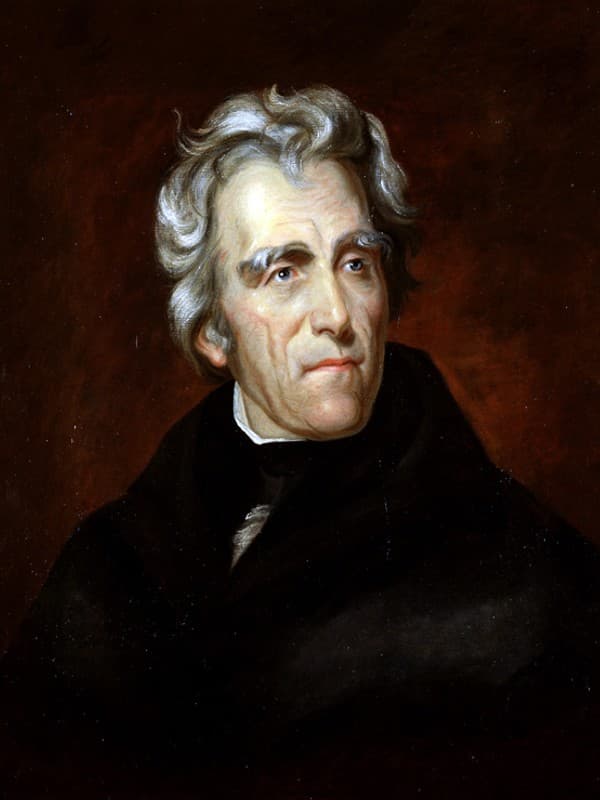
Andrew Jackson
1829–1837• 1803–1848: Expansion, Democracy, and Conflict
Andrew Jackson was born in the Carolina backcountry in 1767 and grew up amid the hardships of the Revolutionary War. Orphaned young, he moved west, became a lawyer, military commander, and political leader in Tennessee. His victory at the Battle of New Orleans in 1815 made him a national hero. After losing the disputed election of 1824, he built a mass political movement and won the presidency in 1828 as the champion of white male democracy and opposition to elite rule.
Jackson’s presidency transformed American politics. He expanded the use of presidential power, strengthened the Democratic Party, and presented himself as the direct representative of the people. His supporters celebrated the growth of popular political participation among white men, while his opponents warned that he threatened constitutional limits. The Nullification Crisis of 1832–1833 tested federal authority when South Carolina resisted federal tariffs; Jackson rejected nullification and defended the Union, even while accepting a compromise tariff.
His administration’s most consequential and destructive policy was Indian removal. Jackson supported and signed the Indian Removal Act of 1830, leading to the forced displacement of Native nations from the Southeast, including the Cherokee, Creek, Choctaw, Chickasaw, and Seminole. The policy violated Native sovereignty and produced enormous suffering, including the Trail of Tears after Jackson left office.
Jackson also challenged the Second Bank of the United States, vetoing its recharter in a battle he cast as a struggle for ordinary Americans against concentrated financial power. His administration paid off the national debt entirely — the only president ever to achieve this. He retired to the Hermitage in Tennessee, where he remained influential in Democratic politics until his death in 1845.
✓ Major Achievements
- 1Expanded mass political participation among white male voters
- 2Strengthened the modern Democratic Party
- 3Defended federal authority during the Nullification Crisis
- 4Used the veto as a major instrument of presidential power
- 5Paid off the national debt during his administration
⚑ Historical Controversies
- 1Signed and enforced Indian removal policy
- 2Defied the spirit of Supreme Court protection for Cherokee sovereignty
- 3Destroyed the Second Bank of the United States
- 4Enslaved people and defended the slaveholding order
- 5Contributed to economic instability before the Panic of 1837
Legacy at 250 Years
Jackson’s presidency speaks directly to America at 250 because it exposes the tension between democratic expansion and exclusion. His era broadened white male suffrage while devastating Native nations and protecting slavery, reminding modern Americans that democracy’s growth has often been tied to struggles over who counts as part of the people.
Key Speeches & Documents
- 📜First Inaugural Address
- 📜Bank Veto Message
- 📜Proclamation Regarding Nullification
About Andrew Jackson
Andrew Jackson rose from a difficult childhood to become a military hero and a powerful political figure. His victory at the Battle of New Orleans made him nationally famous and helped create the image of a leader who spoke for ordinary Americans.
As president, Jackson expanded political participation among white male voters and changed the style of presidential leadership. He presented himself as a direct representative of the people and used the power of the presidency more forcefully than many of his predecessors.
One of Jackson’s most significant achievements was his role in reshaping American democracy and party politics. His presidency left a lasting mark on the office, showing that presidents could build strong public support and lead with a clear political identity.
Historical Era
Sources & Further Reading

Ask Dr. Hart about Andrew Jackson
AI Historical Guide · America 250 Atlas
Dr. Abigail Hart can help you understand Andrew Jackson's presidency, key decisions, historical significance, and place in America's 250-year story.