President #6 • Democratic-Republican / National Republican
John Quincy Adams
1825–1829• 1790s–1820s: The Early Republic
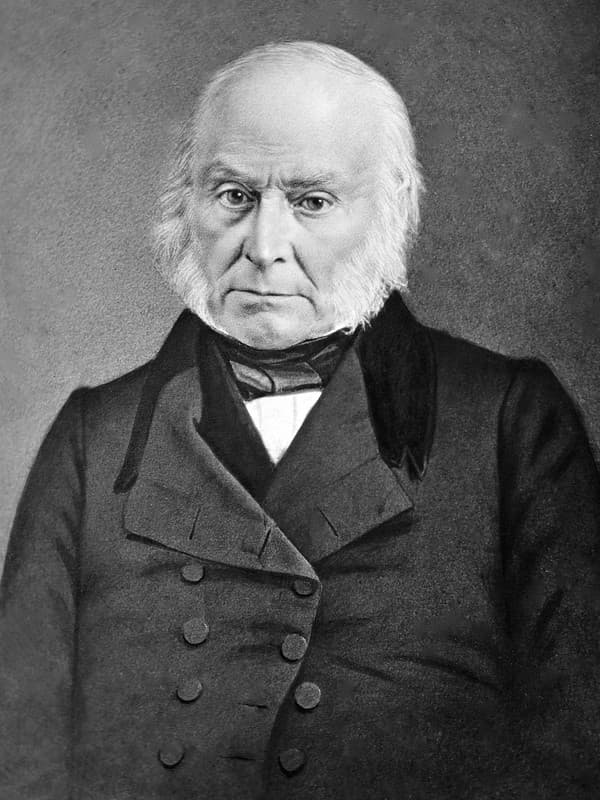
John Quincy Adams was born in Massachusetts in 1767, the son of John and Abigail Adams, and grew up amid the American Revolution. He spent part of his youth in Europe, became fluent in several languages, and entered public life as a diplomat, senator, and secretary of state. As secretary under James Monroe, he helped negotiate the Adams-Onís Treaty and shaped the Monroe Doctrine. In 1824, he won the presidency after a four-way election was decided in the House of Representatives, defeating Andrew Jackson despite Jackson’s plurality in the popular and electoral vote.
Adams entered office under the shadow of what Jackson’s supporters called a “corrupt bargain,” because Henry Clay backed Adams in the House and later became secretary of state. Adams proposed an ambitious national program of internal improvements, scientific advancement, education, roads, canals, and a national university. He believed the federal government should promote national development and public knowledge, but his program faced fierce opposition from Jacksonians and strict constructionists.
His presidency was defined less by crisis than by political obstruction and the breakdown of the old party system. The Tariff of 1828, denounced in the South as the “Tariff of Abominations,” intensified sectional conflict over federal economic policy. Adams also supported Native diplomacy more cautiously than Jackson would, but his administration remained part of a broader expansionist republic that put pressure on Native lands.
Defeated by Andrew Jackson in 1828, Adams did not retire from public life. Instead, he won election to the House of Representatives, where he became a powerful opponent of slavery’s political influence. His fight against the congressional “gag rule” made his post-presidency one of the most consequential in American history. He died in 1848 after collapsing in the Capitol.
✓ Major Achievements
- 1Served as one of the most influential secretaries of state in U.S. history
- 2Helped formulate the Monroe Doctrine
- 3Negotiated the Adams-Onís Treaty acquiring Florida
- 4Proposed a national program of internal improvements and scientific advancement
- 5Led the House fight against the anti-abolitionist gag rule after his presidency
⚑ Historical Controversies
- 1Won the 1824 election through a House vote despite Andrew Jackson’s plurality
- 2Accused by opponents of benefiting from a “corrupt bargain” with Henry Clay
- 3Supported the unpopular Tariff of 1828
- 4Struggled to build an effective governing coalition
Legacy at 250 Years
At America’s 250th anniversary, Adams connects the founding generation to the expanding republic and to the growing constitutional conflict over slavery. His career shows how questions of federal power, national development, free petition, and human bondage remained unresolved after the Revolution.
Key Speeches & Documents
- 📜Inaugural Address
- 📜Annual Messages to Congress
- 📜House speeches against the gag rule
About John Quincy Adams
John Quincy Adams had one of the most impressive public careers in American history. Before becoming president, he served as a diplomat, senator, secretary of state, and negotiator, gaining deep knowledge of foreign affairs.
As secretary of state, Adams helped shape the Monroe Doctrine and negotiated important agreements, including the Adams-Onís Treaty, which brought Florida under United States control. As president, he supported national improvements such as roads, canals, education, and scientific advancement.
After leaving the White House, Adams achieved one of his most admired accomplishments by serving in the House of Representatives. There he became a strong voice for the right of citizens to petition their government and for moral courage in public debate.
Historical Era
Sources & Further Reading

Ask Dr. Hart about John Quincy Adams
AI Historical Guide · America 250 Atlas
Dr. Abigail Hart can help you understand John Quincy Adams's presidency, key decisions, historical significance, and place in America's 250-year story.