President #32 • Democratic
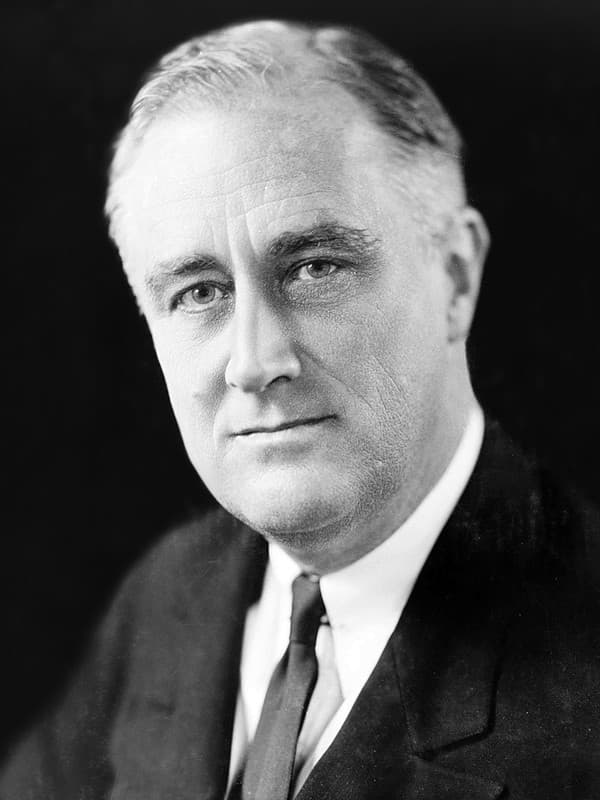
Franklin D. Roosevelt
1933–1945• 1914–1945: World Wars and Global Power
Franklin D. Roosevelt was born in 1882 into a wealthy New York family and entered public life as a state senator, assistant secretary of the navy, and Democratic vice-presidential nominee in 1920. After contracting polio in 1921, he rebuilt his career and served as governor of New York during the early Great Depression. Elected president in 1932, he took office in 1933 amid bank failures, mass unemployment, and national despair.
Roosevelt’s New Deal transformed the role of the federal government. In his first hundred days, Congress passed emergency banking legislation, relief programs, public works measures, and financial reforms. Later New Deal laws included Social Security in 1935, labor protections, rural electrification, and expanded federal responsibility for economic security. Critics attacked the New Deal as either too radical or too cautious, and his 1937 court-packing plan damaged his standing.
Foreign policy and World War II dominated his later presidency. Roosevelt moved gradually from neutrality toward support for Britain and other Allies through measures such as Lend-Lease. After Japan attacked Pearl Harbor on December 7, 1941, he led the United States into a global war against Imperial Japan, Nazi Germany, and their allies.
Roosevelt was elected to four terms, the only president to serve more than two. He helped shape the Allied strategy and the postwar world but died on April 12, 1945, shortly before Germany’s surrender. His record stands as a testament to extraordinary leadership through the two greatest crises of the 20th century, leaving the world more democratic and more hopeful than the one he inherited.
✓ Major Achievements
- 1New Deal — transformed American social safety net
- 2Led Allied coalition through World War II
- 3Social Security Act (1935)
- 4Lend-Lease Act supporting Britain before Pearl Harbor
⚑ Historical Controversies
- 1Japanese-American internment (Executive Order 9066)
- 2Court-packing plan (1937)
- 3Delayed U.S. entry into World War II
Legacy at 250 Years
FDR's New Deal created the social contract that defined 20th-century American life. His leadership through existential crises set the model for presidential crisis management that successors are still measured against.
Key Speeches & Documents
- 📜First Inaugural Address (1933)
- 📜Day of Infamy Address (1941)
- 📜Four Freedoms Speech (1941)
About Franklin D. Roosevelt
Franklin D. Roosevelt led the United States through two enormous challenges: the Great Depression and World War II. His confidence, communication skills, and willingness to experiment made him a central figure of the twentieth century.
During the Depression, Roosevelt introduced the New Deal, a broad set of programs designed to provide relief, create jobs, reform financial systems, and restore hope. Programs such as Social Security became lasting parts of American life.
One of Roosevelt’s most significant achievements was guiding the nation as it became a major force in the Allied victory during World War II. His leadership helped mobilize American industry, build alliances, and prepare the country for a larger role in the world.
Historical Era
Sources & Further Reading

Ask Dr. Hart about Franklin D. Roosevelt
AI Historical Guide · America 250 Atlas
Dr. Abigail Hart can help you understand Franklin D. Roosevelt's presidency, key decisions, historical significance, and place in America's 250-year story.