President #31 • Republican
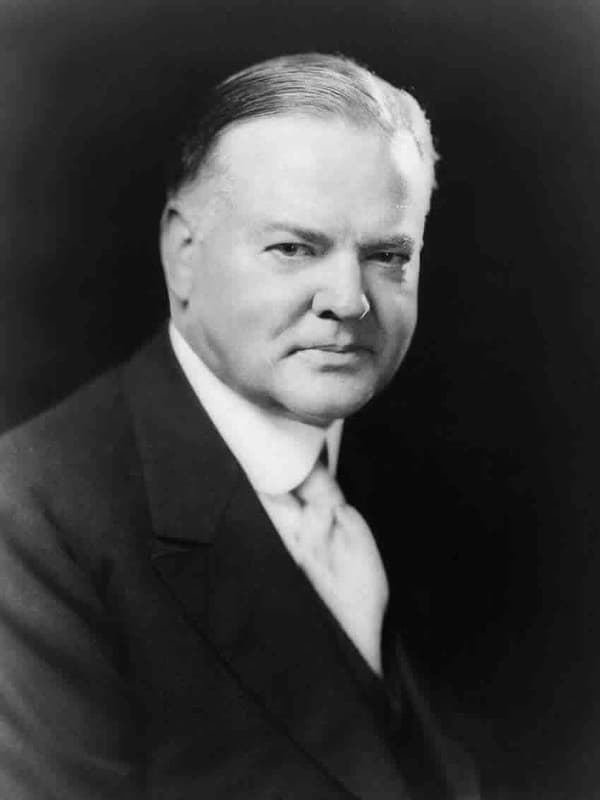
Herbert Hoover
1929–1933• 1914–1945: World Wars and Global Power
Herbert Hoover was born in Iowa in 1874, orphaned as a child, and later became a mining engineer, international businessman, and humanitarian. He gained global respect for organizing food relief in Europe during and after World War I. As secretary of commerce under Harding and Coolidge, he promoted efficiency, voluntary cooperation between business and government, and modern economic planning without broad federal welfare. In 1928, he won the presidency by a large margin.
Only months after Hoover took office, the stock market crashed in October 1929. What began as a financial crisis became the Great Depression, with bank failures, unemployment, farm collapse, business failures, and widespread poverty. Hoover believed in voluntary cooperation, local relief, and limited federal intervention, but the crisis overwhelmed these methods.
As conditions worsened, Hoover expanded federal action more than his reputation sometimes suggests. He supported public works, the Reconstruction Finance Corporation, and measures to stabilize banks and businesses. Still, he resisted direct federal relief to individuals and was widely seen as detached from ordinary suffering. The dispersal of veterans who had gathered in Washington in 1932 was a painful moment for an administration that genuinely respected their service.
Hoover lost the 1932 election overwhelmingly to Franklin D. Roosevelt. In retirement, he became a critic of the New Deal but later returned to public service, advising presidents and leading commissions on government reorganization. He lived until 1964. In later decades, Hoover served the nation again, leading major reorganization commissions that helped modernize the federal government — a testament to his lifelong dedication to capable and efficient public service.
✓ Major Achievements
- 1Built a major humanitarian reputation through World War I-era food relief
- 2Expanded the role of the Commerce Department before becoming president
- 3Created the Reconstruction Finance Corporation
- 4Supported some public works and bank stabilization efforts
- 5Later led commissions on federal government reorganization
⚑ Historical Controversies
- 1Failed to stop the Great Depression’s deepening
- 2Opposed large-scale direct federal relief to individuals
- 3Was seen as indifferent to mass unemployment and poverty
- 4Bonus Army removal damaged his reputation
- 5Signed the Smoot-Hawley Tariff, which worsened international trade tensions
Legacy at 250 Years
Hoover’s presidency connects America at 250 to the question of what citizens can expect from government in a national economic emergency. His failure during the Depression reshaped American political thought by showing that older models of voluntary relief and limited intervention could not meet modern economic collapse.
Key Speeches & Documents
- 📜Inaugural Address
- 📜Messages on the Economic Crisis
- 📜Address on the Reconstruction Finance Corporation
About Herbert Hoover
Herbert Hoover was widely admired before his presidency as an engineer, organizer, and humanitarian. During and after World War I, he helped lead major relief efforts that provided food to millions of people in Europe.
As president, Hoover faced the Great Depression, a crisis that overwhelmed many of the economic ideas and tools of the time. He supported public works and relief efforts, but the downturn deepened and caused widespread hardship.
One of Hoover’s most significant achievements came before he entered the White House: his humanitarian leadership. His relief work showed exceptional organizational skill and a strong belief that public service could reduce suffering on a large scale.
Historical Era
Sources & Further Reading

Ask Dr. Hart about Herbert Hoover
AI Historical Guide · America 250 Atlas
Dr. Abigail Hart can help you understand Herbert Hoover's presidency, key decisions, historical significance, and place in America's 250-year story.