President #19 • Republican
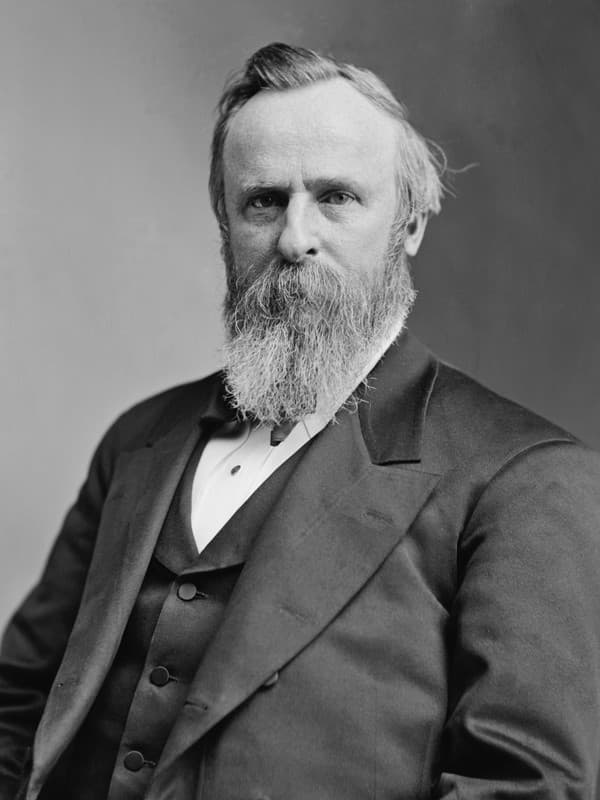
Rutherford B. Hayes
1877–1881• 1877–1914: Industrial America and Reform
Rutherford B. Hayes was born in Ohio in 1822 and became a lawyer, Civil War officer, congressman, and governor. He earned a reputation for personal integrity and moderate reform. In 1876, Republicans nominated him for president against Democrat Samuel J. Tilden. The election became one of the most disputed in American history, with contested results in several Southern states.
Hayes became president after an electoral commission awarded him the disputed electoral votes, giving him a one-vote Electoral College victory. The outcome was linked to the Compromise of 1877, an informal political settlement associated with the withdrawal of remaining federal troops from the South. This effectively marked the end of Reconstruction and left Black citizens in the South increasingly exposed to disfranchisement, segregation, and racial violence.
Hayes tried to promote civil service reform and a more professional federal government. He challenged the patronage system, including disputes with powerful New York Republicans, and supported merit-based appointments. His administration also faced the Great Railroad Strike of 1877, one of the first major national labor uprisings, which revealed the tensions of industrial capitalism and federal power.
Hayes kept his promise to serve only one term and left office in 1881. In retirement, he supported education, prison reform, and some civil rights causes. His personal honesty was widely respected, but his presidency remains defined by the disputed election and the retreat from federal enforcement of Reconstruction.
✓ Major Achievements
- 1Advanced civil service reform
- 2Maintained a reputation for personal integrity
- 3Challenged parts of the patronage system
- 4Promoted education and reform causes after his presidency
⚑ Historical Controversies
- 1Took office after the disputed election of 1876
- 2Associated with the Compromise of 1877
- 3Withdrew remaining federal troops from the South
- 4Presided over the effective end of Reconstruction
- 5Used federal troops during the Great Railroad Strike of 1877
Legacy at 250 Years
Hayes’s presidency connects America at 250 to the fragility of voting rights, federal enforcement, and postwar constitutional promises. The end of Reconstruction shows how democratic rights can be narrowed when political compromise takes priority over equal citizenship.
Key Speeches & Documents
- 📜Inaugural Address
- 📜Messages on Civil Service Reform
- 📜Annual Messages to Congress
About Rutherford B. Hayes
Rutherford B. Hayes was a Civil War veteran, lawyer, and governor of Ohio before becoming president. He entered office after a disputed election and worked to restore confidence in government.
Hayes promoted civil service reform, arguing that government jobs should be based more on merit than political loyalty. He also tried to calm sectional tensions after the long struggle of Reconstruction.
One of Hayes’s most significant achievements was strengthening the idea that public service should be honest and professional. His presidency helped prepare the way for later reforms that made the federal government more modern and less dependent on patronage.
Historical Era
Sources & Further Reading

Ask Dr. Hart about Rutherford B. Hayes
AI Historical Guide · America 250 Atlas
Dr. Abigail Hart can help you understand Rutherford B. Hayes's presidency, key decisions, historical significance, and place in America's 250-year story.