President #22 • Democratic
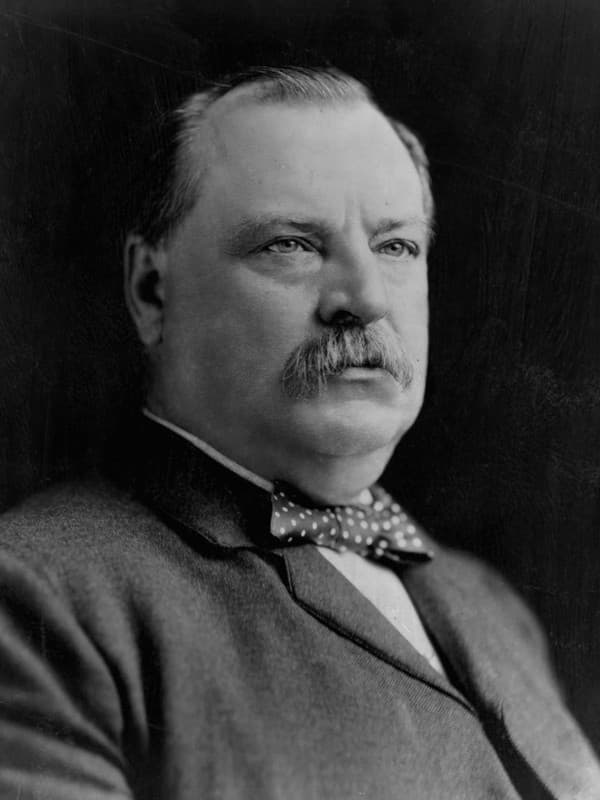
Grover Cleveland
1885–1889, 1893–1897• 1877–1914: Industrial America and Reform
Grover Cleveland was born in New Jersey in 1837 and built his political career in New York as sheriff of Erie County, mayor of Buffalo, and governor of New York. He gained a reputation for personal honesty, vetoing wasteful legislation and challenging machine politics. In 1884, Democrats nominated him as a reform candidate, and he narrowly defeated Republican James G. Blaine to become the first Democratic president elected after the Civil War.
Cleveland’s first term emphasized limited government, tariff reduction, and opposition to what he viewed as special-interest spending. He vetoed many pension bills and resisted federal aid proposals, believing that public money should be carefully guarded. His administration also confronted labor unrest and continued federal policies toward Native peoples that promoted allotment and assimilation, including the Dawes Act of 1887.
Defeated by Benjamin Harrison in 1888 despite winning the popular vote, Cleveland returned in 1892 and became the only president before Donald Trump to serve nonconsecutive terms. His second term was dominated by the Panic of 1893, a severe economic depression. Cleveland defended the gold standard and repealed the Sherman Silver Purchase Act, angering many farmers, workers, and silver advocates.
In 1894, Cleveland sent federal troops to break the Pullman Strike, arguing that the strike interfered with mail delivery and interstate commerce. This action demonstrated his commitment to upholding the law and ensuring the stability of commerce and government operations. He also opposed the annexation of Hawaii after investigating the overthrow of Queen Liliuokalani. Cleveland left office in 1897, increasingly estranged from the populist and silver wing of his party, and died in 1908.
✓ Major Achievements
- 1First Democratic president elected after the Civil War
- 2Only president before Donald Trump to serve nonconsecutive terms
- 3Advanced civil service and anti-corruption reform
- 4Opposed annexation of Hawaii after the overthrow of Queen Liliuokalani
- 5Defended fiscal restraint and limited government principles
⚑ Historical Controversies
- 1Sent federal troops to break the Pullman Strike
- 2Opposed many federal relief efforts during economic hardship
- 3Defended the gold standard during the Panic of 1893
- 4Signed or enforced policies that advanced Native allotment and assimilation
- 5Lost support among farmers, workers, and silver Democrats
Legacy at 250 Years
Cleveland’s presidency connects America at 250 to debates over limited government, economic crisis, labor rights, and American expansion abroad. His record shows how Gilded Age leaders struggled to govern a nation transformed by corporations, industrial labor, monetary conflict, and overseas ambition.
Key Speeches & Documents
- 📜First Inaugural Address
- 📜Second Inaugural Address
- 📜Messages on Tariff Reform
- 📜Messages on the Pullman Strike and Hawaii
About Grover Cleveland
Grover Cleveland was known for his independence, personal honesty, and willingness to say no when he believed public money was being used unwisely. Before becoming president, he served as mayor of Buffalo and governor of New York.
Cleveland is the only president to serve two nonconsecutive terms. He emphasized limited government, fiscal responsibility, and a strong sense of duty to the public interest.
One of Cleveland’s significant achievements was strengthening expectations of honesty and independence in the presidency. Even critics often recognized his seriousness and his determination to place principle above easy popularity.
Historical Era
Sources & Further Reading

Ask Dr. Hart about Grover Cleveland
AI Historical Guide · America 250 Atlas
Dr. Abigail Hart can help you understand Grover Cleveland's presidency, key decisions, historical significance, and place in America's 250-year story.